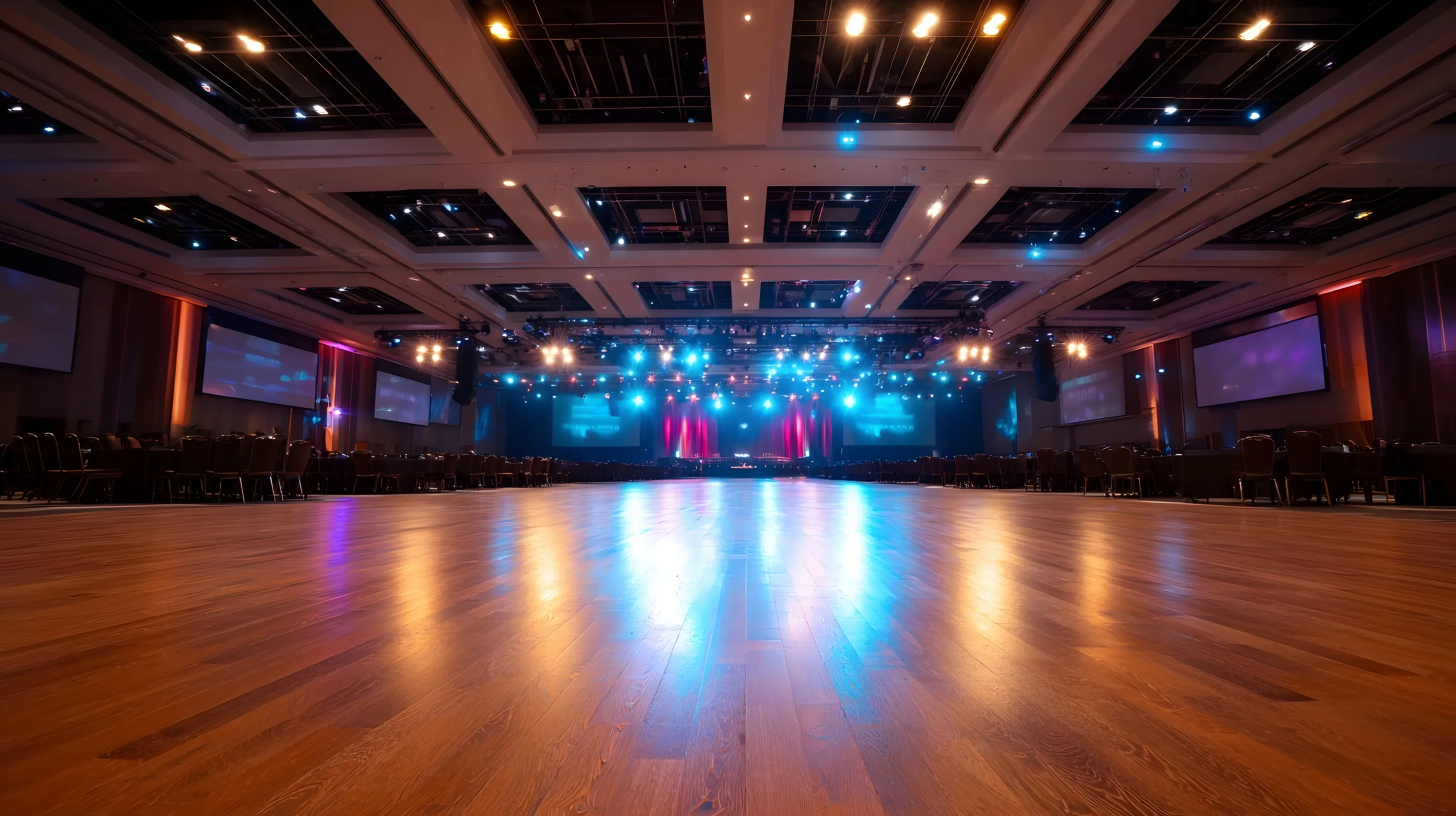
Which Floor Options Hold up the Best for Concerts, Conferences, and Crowds?
Summary
Packed venues put constant stress on floors, from dragged equipment and rolling risers to thousands of footsteps in a single night. Consolidated Flooring breaks down which surfaces actually hold up under that kind of traffic, so event spaces stay safe and look sharp show after show.
The best flooring for concerts, conferences, and crowds is a zone-based mix — sealed concrete or 5mm LVT for main event floors, acoustic carpet tile for conference and breakout rooms, and rubber or sheet goods for back-of-house. The right choice depends on traffic volume, spill risk, rolling loads, and turnaround time. Match each zone to its real workload and one venue can host a sold-out concert one night and a corporate conference the next.
Key Takeaways
There is no single best floor: high-performing event venue flooring is specified zone by zone, matching each product to traffic, spills, rolling loads, and turnaround windows.
- Main event floors favor sealed or polished concrete and 5mm wear-layer LVT for durability, cleanability, and heavy rolling loads.
- Conference and breakout rooms rely on acoustic carpet tile for sound absorption, speech clarity, and modular spot-replacement.
- Slip resistance matters in crowded, spill-prone zones: target a wet DCOF of 0.42 or higher per ANSI/NFSI B101 standards.
- Temporary and outdoor events call for portable/modular tile, rollable vinyl, and ground protection mats that install and tear down fast.
Why Is Event Space Flooring a Harder Problem Than Most Commercial Flooring?
Standard commercial flooring specs are built around predictable patterns: known occupancy, consistent daily traffic, and regular maintenance windows. Event spaces throw all of that out. A convention hall might see 8,000 people in a single day, with A/V carts, staging risers, and scissor lifts crossing the same floor, then need to look presentation-ready for a corporate gala the following morning.
A single high-attendance event can deliver the equivalent of months of standard commercial traffic in eight hours. Spill frequency is higher, rolling loads are heavier, and turnaround windows are shorter than almost any other venue type. Office-grade LVT or retail-spec broadloom weren’t engineered for that. The right high-traffic event venue flooring decision depends on what you’re hosting: concert venues, conference centers, and multi-use spaces each deserve their own framework.
For a full framework across venue types, see our best commercial flooring for event venues (2026 guide)
What Flooring Holds up Best in Concert Venues and Live Event Spaces?
Concert venues prioritize durability and cleanability above almost everything else. The main floor takes the hardest punishment: dense crowds, drink spills, staging equipment rolling across the same surface, and post-show cleanup that has to be fast.
Polished or sealed concrete is the workhorse choice for main event floors and load-in areas. It handles rolling loads from forklifts and road cases, cleans quickly after spills, and its reflective surface interacts well with stage lighting. It requires periodic resealing and can get slick when wet, so slip-resistant event flooring measures like aggregate finishes in high-spill zones are worth building into the spec.
5mm wear layer LVT suits venues that want a warmer aesthetic. Wood-look planks read as upscale, are waterproof, and are more forgiving underfoot than concrete during long-standing events. Homogeneous sheet or rubber sheet belongs in back-of-house corridors and load-in bays, where the priority is surviving constant equipment movement. Walk-off carpet and entrance grids at primary entries protect the primary floor from debris tracked in by large crowds.
Event Venue Flooring at a Glance: A Comparison Table
|
Flooring Type |
Durability / Load |
Slip Resistance |
Install/Teardown |
Relative Cost |
Best For |
|
Sealed/polished concrete |
Excellent (rolling loads) |
Low when wet (add aggregate) |
Permanent |
$ |
Main floors, load-in |
|
5mm LVT |
High |
Good (matte/textured) |
Moderate |
$$ |
Main floors, pre-function |
|
Carpet tile (SD nylon) |
High (spot-replace) |
Good |
Modular |
$$ |
Conference/breakout, acoustics |
|
Broadloom carpet |
Medium-high |
Good |
Slower |
$$ |
Ballrooms, formal |
|
Rubber / homogeneous sheet |
Excellent |
Excellent |
Permanent |
$$ |
Back-of-house, load-in |
|
Portable/modular tile |
Medium |
Varies |
Fast, reusable |
$-$$ |
Temporary/expo/outdoor |
Does Carpet Have Any Place in a Concert Venue?
Yes, in specific zones. Lobbies, VIP lounges, and seated balcony sections benefit from the acoustic absorption and underfoot comfort that carpet provides. Carpet tile allows spot replacement when sections show wear, which is a practical advantage over broadloom in high-traffic event settings. For concert venue flooring, solution-dyed nylon fiber holds color through staining and multiple commercial cleanings. Check the TARR rating (Texture Appearance Retention Rating) on any carpet product you’re evaluating: it’s the industry benchmark for predicting performance under sustained commercial traffic.
What’s the Right Flooring for Conference Centers and Corporate Event Spaces?
Conference center flooring carries a different set of demands. Rolling chairs are constant, setups get reconfigured multiple times per day, and the visual standard is higher than a concert venue.
Carpet tile is the workhorse spec for conference rooms and breakout spaces. It delivers real acoustic value: mass and texture absorb room noise and improve speech intelligibility in ways hard surfaces can’t match. Tight-loop or tip-shear constructions with appropriate TARR ratings handle rolling chair loads better than cut-pile constructions, which compress and mat over time. Broadloom carpet is the right call for ballrooms and formal conference settings where seamless appearance matters more than modular maintainability.
In pre-function areas, registration desks, and food service stations, LVT in event spaces outperforms carpet. These are the highest-spill zones in any conference setting, and hard surface is the practical choice.
When Does Acoustic Flooring Matter in a Conference Center?
When conference spaces are stacked above other meeting rooms or hotel accommodations, impact noise from foot traffic becomes an operational problem. IIC (Impact Insulation Class) and ICC ratings measure how well a flooring assembly blocks that transmission. Acoustic flooring systems with cushion backing or underlayment can meaningfully reduce sound transfer through the floor structure, and specifying this upfront costs far less than retrofitting it later.
How Do You Spec Flooring for a Venue That Does Both Concerts and Conferences?
Multi-use venue flooring requires a zone-based strategy. Trying to find one material that performs equally well across a main event floor, conference breakout rooms, a lobby, and back-of-house corridors means compromising everywhere.
The main floor and primary event space suits sealed concrete or 5mm LVT: durable for both concert and conference configurations and easy to clean between events. Breakout rooms and meeting areas call for carpet tile for acoustic benefit and modular maintainability. At the entry, lobby, and pre-function level, walk-off carpet or entrance grids at the threshold transition into LVT or polished concrete for the main traffic volume. Back-of-house and load-in corridors need rubber or homogeneous sheet flooring, specified for utility rather than appearance.
A manufacturer-agnostic flooring dealer is better positioned to spec these zones correctly than a single-brand representative. Each zone has a genuinely right product, and it won’t always come from the same manufacturer.
What Temporary or Portable Flooring Works for Events?
Not every event calls for permanent flooring. Pop-up galas, trade shows, and expo halls often need a surface that installs Friday and disappears Sunday, which is where temporary event flooring earns its keep. Interlocking modular tile snaps together over concrete, turf, or uneven subfloors and breaks down for reuse at the next show — a practical fit for portable/modular event flooring programs that travel between venues. Rollable vinyl (sheet vinyl in wide rolls) lays down quickly across large expo footprints, offers a clean printable or solid-color surface for booths and aisles, and rolls back up for storage. For trade show / expo hall flooring, look for products rated for repeated installation cycles, since edges and seams take abuse each time they’re handled. Portable systems trade some long-term durability for speed and reusability, so they’re best matched to events that recur rather than to daily permanent traffic.
What Flooring Works for Outdoor Concerts and Events?
Outdoor concerts, festivals, and tented events add weather, mud, and grass protection to the equation. Ground protection mats — heavy-duty interlocking or overlapping panels — distribute vehicle and crowd loads across soft ground, keep walkways stable, and prevent ruts during load-in and load-out. Turf protection flooring is designed specifically to sit over stadium grass or landscaped lawns: it lets the turf breathe for short durations while carrying foot traffic, staging, and light vehicles without killing the grass beneath. For temporary outdoor stages and VIP areas, portable modular tile provides a level, slip-aware surface over uneven terrain. Because outdoor conditions are unpredictable, prioritize drainage, traction when wet, and panels rated for the point loads your equipment will impose. Crowd safety outdoors is as much about stable footing as it is indoors — our guidance on how to improve safety in public event spaces applies to open-air venues too.
How Do Point Loads and Rolling Loads Affect Flooring Choice?
Event floors fail at their weakest load point, so spec around the loads your venue actually imposes. Rolling loads — A/V carts, road cases, pallet jacks, and scissor lifts crossing the same lanes — call for hard, dimensionally stable surfaces like sealed concrete, rubber/homogeneous sheet, or thicker-wear-layer LVT that won’t gouge or telegraph. Point loads — the concentrated weight under staging jacks, riser legs, and equipment feet — can dent softer surfaces and even damage the subfloor if the load isn’t distributed. Ask manufacturers for static load performance tested to ASTM F970 (static load limit for resilient flooring) and related ASTM load standards (https://www.astm.org/), and use load-spreading plates under concentrated point loads. Matching the flooring’s rated load to the heaviest cart, lift, or riser leg it will carry is the difference between a floor that lasts a decade and one that shows damage after the first big show.
A Note on Slip Resistance
In crowded, spill-prone event spaces, traction is a safety spec, not an afterthought. The widely referenced benchmark for walkway safety is a wet dynamic coefficient of friction (DCOF) of 0.42 or higher, per ANSI/NFSI B101 test standards. Concrete and glossy hard surfaces can fall below that when wet, so add aggregate finishes, textured LVT, or slip-resistant treatments in bar, concession, and entry zones. Specifying slip-resistant flooring by measured DCOF — rather than by look — protects guests and reduces liability.
A Note on Install and Teardown Speed
Turnaround time is often the deciding factor between two otherwise capable products. Permanent surfaces like sealed concrete and rubber sheet install once and stay put, but they take a venue offline during installation and curing. Modular systems — carpet tile, interlocking portable tile, and click-together LVT — go down and come up fast, which matters when the room flips from a concert to a conference overnight. Rollable vinyl covers large areas quickly for expos, while broadloom and wet-set installations are the slowest to place and remove. If your calendar is tight between events, weight install/teardown speed alongside durability and cost.
How Does Consolidated Flooring Spec Permanent Flooring for High-Volume Event Spaces?
We’ve been specifying commercial flooring for public venues for over 80 years. Our portfolio includes work at major event destinations like the Javits Center, where flooring decisions get tested under real conditions at scale. As a family-owned commercial flooring dealer and Starnet Worldwide Commercial Flooring Partnership member, we source from leading manufacturers without being tied to a single product line. Our skilled installation mechanics and flooring craftspeople handle specification, floor preparation, installation, and ongoing maintenance across all venue types.
If your venue is approaching a capital improvement or a new event space build-out, schedule a call with Consolidated Flooring today.