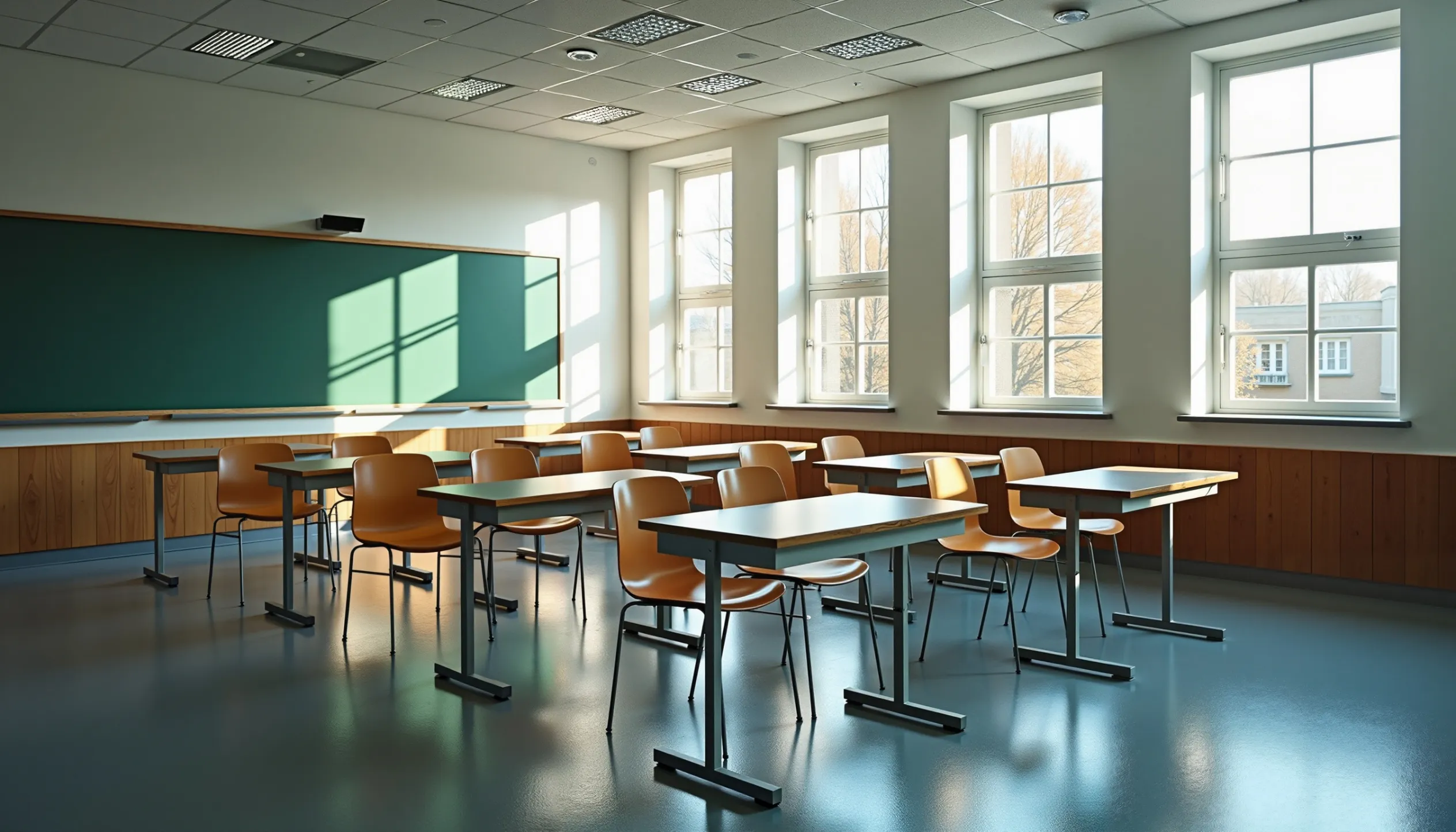
What Flooring Types Reduce Noise In Classrooms And Hallways In Schools?
Summary
The right K-12 flooring choices, including carpet tile in classrooms, rubber in hallways, and hybrid resilient where cleanability matters, directly impact stud…The right K-12 flooring choices, including carpet tile in classrooms, rubber in hallways, and hybrid resilient where cleanability matters, directly impact student learning by controlling both impact and airborne noise.
For most classrooms, carpet tile is the best flooring to reduce noise; for hallways, rubber flooring performs best under heavy traffic.
Noise is one of the most underestimated obstacles in K-12 learning environments. When the floor echoes every footstep, dragged chair, and dropped book, students pay the price. Literally. Research shows that poor classroom acoustics negatively affect children’s memory, attention, and reading skills, with impacts that are even more pronounced for students learning English or those with hearing difficulties.
Choosing the right K-12 education flooring isn’t just an aesthetic or budget call. It’s a decision that directly shapes how well students can learn. Let’s dig into what actually works.
Why Does Flooring Have Such a Big Impact on Classroom Noise?
Flooring is the one surface in every classroom that gets hit constantly, all day long. Those impacts from feet and furniture generate noise that travels through the building structure and into the room itself. The floor doesn’t just generate that sound; it either absorbs it or sends it bouncing off every hard surface in the room.
What’s the Difference Between Impact Noise and Airborne Noise in Schools?
These are two distinct problems, and your flooring needs to address both. Impact noise is structure-borne: the thud of footsteps in the hallway above, a chair scraping across concrete, a backpack hitting the floor. Airborne noise is what travels through the air: voices, HVAC hum, and the general roar of 30 kids in a room.
Hard resilient flooring like polished concrete or VCT does almost nothing to absorb either. Every impact becomes a sound event, and every sound event reverberates off the hard surfaces around it. Soft and acoustically engineered flooring intercepts impact energy before it enters the structure and absorbs airborne sound before it builds into classroom chaos.
What Do IIC, NRC & STC Ratings Mean for School Flooring?
These two numbers tell you how well a floor product performs acoustically. IIC rating school flooring refers to Impact Insulation Class. The higher the number, the better the floor prevents structure-borne noise from traveling through the building. An NRC (Noise Reduction Coefficient) rating measures how much airborne sound a surface absorbs rather than reflects, on a scale from 0 to 1, where higher numbers indicate greater sound absorption.
A bare concrete slab can fall below IIC 35 with no finish flooring. Acoustically engineered floor covering can reduce structure-borne noise (IIC) by up to 126% versus polished concrete, while reducing airborne noise (NRC) by as much as 100%. Those aren’t marginal improvements; that’s the difference between a room where students can hear their teacher and one where they’re constantly straining.
A third rating, STC (Sound Transmission Class), measures sound blocked between rooms; classroom doors typically target STC 30+, while ANSI/ASA S12.60 recommends IIC 45–50 for floor/ceiling assemblies over core learning spaces and NRC 0.75–0.90 for classrooms. These metrics are measured under standardized ASTM E492 (IIC) and E90 (STC) test methods.
Which Flooring Types Are Best at Reducing Noise in Classrooms?
The short answer: soft and hybrid products significantly outperform hard resilient floors. But the right choice depends on the space, the traffic level, and what your maintenance team can realistically handle.
School Noise-Reducing Flooring Comparison Table
The table below compares the most common school flooring solutions for noise control, so you can weigh impact-noise (IIC) and sound-absorption (NRC) performance against durability, maintenance, comfort, and cost at a glance.
| Flooring Type | Impact Noise (IIC) | Sound Absorption (NRC) | Durability | Maintenance | Comfort | Cost | Best For |
|---|---|---|---|---|---|---|---|
| Carpet Tile | Excellent | High (0.30–0.45) | High | Moderate | High | $$ | Classrooms |
| Broadloom Carpet | Excellent | Highest | Medium | Higher | High | $$ | Libraries/quiet rooms |
| Rubber | Very Good | Medium | Very High | Easy | High | $$$ | Hallways/high-traffic |
| Acoustic-backed LVT | Good (w/ underlay) | Low–Med | Very High | Easy | Medium | $$ | Budget/durability |
| Hybrid Resilient / Powerbond | Very Good | Med | High | Easy | Medium | $$ | Cleanability + acoustics |
| Cork / Cork-backed Vinyl | Good | Med | Medium | Moderate | High | $$$ | Natural absorption (~25% noise cut) |
| Linoleum | Fair | Low | High | Easy | Medium | $$ | Low-VOC durable |
| Polished Concrete / VCT (avoid) | Poor | Very Low | Excellent | Very Easy | Low | $ | Avoid for acoustics |
Does Carpet Tile Actually Outperform Hard Flooring for Acoustics?
Yes, by a wide margin. Carpet tile classrooms deliver superior performance on both IIC and NRC. Carpet and pad assemblies more readily satisfy acoustic thresholds. In contrast, hard-surface flooring like LVT or ceramic tile requires a tested acoustic underlayment just to meet the code-minimum IIC levels. Carpet intercepts impact at the surface before it enters the structure, and the fiber itself absorbs airborne sound that would otherwise bounce around the room.
Commercial carpet in a classroom also offers practical advantages. Modular tile makes partial replacement easy, pattern options support wayfinding, and cushion-backed products like broadloom classroom flooring with moisture barrier backing add a layer of comfort that reduces fatigue for both students and teachers.
Broadloom Carpet: Maximum Sound Absorption
Broadloom (wall-to-wall) carpet delivers the highest airborne sound absorption of any school flooring, making it ideal for libraries, media centers, and quiet-focus rooms where reverberation must be kept to a minimum. Its seamless expanse and cushioned backing soften both footfall impact and voice noise. The trade-off is higher maintenance and lower stain resilience than modular tile, so it’s best reserved for lower-traffic, sound-sensitive spaces.
Hybrid Resilient / Powerbond: When Cleanability Matters
Hybrid resilient flooring and Powerbond flooring hit a sweet spot that straight carpet can’t always reach. These products combine a carpet-like surface with the performance of welded sheet resilient flooring, making them easier to clean, more resistant to heavy rolling loads, and acoustically superior to standard hard resilient. The closed-cell cushion backing in Powerbond reduces footfall impact and lowers airborne reverberation significantly, making it one of the strongest acoustic performers available for active learning environments. If your district is managing higher-traffic classrooms, science labs, or maker spaces where cleanability is non-negotiable, hybrid resilient is a strong call.
Acoustic-Backed LVT & Underlayment: Best Budget Option
Luxury vinyl tile (LVT) is prized for durability and easy cleaning, but on its own it reflects sound like any hard surface. Paired with an acoustic backing or a tested underlayment, acoustic-backed LVT reaches code-minimum IIC levels while keeping costs down. It’s a smart budget pick where wipe-clean durability matters more than maximum sound absorption.
Cork & Cork-Backed Vinyl: Natural Sound Absorption
Cork is a naturally resilient, renewable material whose cellular structure absorbs both impact and airborne sound. Cork-backed vinyl combines that acoustic cushion with a durable, cleanable wear layer, and can cut noise by roughly 25% compared with hard resilient floors. It brings warmth and comfort underfoot, though it carries a premium price and needs periodic sealing.
Linoleum: Durable, Low-VOC Alternative
Linoleum is a durable, low-VOC flooring made from natural materials like linseed oil and cork dust, a plus for schools prioritizing indoor air quality. It’s easy to maintain and long-lasting, but as a firm resilient surface its acoustic performance is only fair unless paired with an acoustic underlayment. Consider it where sustainability and durability outweigh the need for high sound absorption.
Ready to spec the right acoustic floor for your building? Request a flooring quote and our team will help you match each space to the best noise-reducing option for your budget and traffic level.
What’s the Best Noise-Reducing Flooring for School Hallways and Common Areas?
Hallways present a different challenge than classrooms. Traffic is heavier, maintenance expectations are higher, and the acoustic problem is more about controlling impact noise than managing airborne reverberation.
Rubber Flooring: Best for High-Traffic Hallways
Absolutely. Rubber flooring for school hallways is one of our most-recommended solutions for high-traffic circulation areas. Rubber tile and rubber sheet are exceptionally durable, inherently slip-resistant, and contribute meaningfully to IIC performance. They hold up under heavy foot traffic, wheeled carts, and the daily punishment a school hallway takes — the same qualities that make rubber one of the best flooring types for high-traffic areas in schools — all without sacrificing the acoustic benefit you’d lose by going back to VCT or polished concrete.. Homogeneous sheet rubber in particular offers seamless installation options that eliminate grout lines where dirt accumulates, which matters a lot for facilities teams managing cleaning schedules.
Flooring to Avoid: Polished Concrete, VCT & Hard Tile
Bare polished concrete, vinyl composition tile (VCT), and hard ceramic tile are extremely durable and easy to clean, but they’re the worst performers for acoustics. Each reflects rather than absorbs sound, turning every footstep, chair scrape, and voice into reverberation that raises classroom and hallway noise. Unless paired with substantial acoustic treatment elsewhere, these surfaces should be avoided in learning and high-traffic circulation spaces.
How Do You Balance Acoustic Performance With Durability and Budget?
This is the real-world question that every facilities director and district planner needs answered before any product spec meeting. The answer isn’t choosing one priority over another; it’s making the right trade-offs depending on the space.
What Happens If You Choose High-Traffic Flooring With No Acoustic Consideration?
You get a building that performs well on the maintenance checklist but fails in the classroom. Inadequate acoustic environments impair basic cognitive functions like attention and memory, both of which are essential for learning and academic success. Schools that default to hard resilient floors purely for ease of maintenance often end up spending more: on supplemental acoustic treatments, on teacher voice strain, and on the long-term learning costs that poor acoustics create.
The good news is that durability and acoustics don’t have to be in conflict. LVT school flooring with a proper acoustic underlayment, rubber tile in hallways, and carpet tile or Powerbond in classrooms can all be designed into a cohesive spec that hits durability benchmarks without sacrificing performance. The key is treating the floor system, not just the product, as the acoustic solution.
How Does Consolidated Flooring Help Schools Get the Acoustic Flooring Right?
We’ve been doing this for over 80 years, and acoustic flooring for schools is one of the areas where our experience shows most clearly. We work with facilities directors, school business administrators, architects, and general contractors from the specification stage through installation and long-term maintenance. Plus, we understand the constraints schools operate under, from tight timelines that have to work around academic calendars to budget structures that demand both performance and value.
As members of Starnet and the Fuse Commercial Flooring Alliance, we bring national buying power and vetted product access to every project. We also support sustainability goals through reclamation and landfill diversion programs, a relevant factor for schools pursuing LEED certification or district-wide sustainability commitments. Whether you’re speccing a new build or replacing flooring in an occupied building, we’ll help you find the right product for every space. Reach out to Consolidated Flooring to start the conversation.
Frequently Asked Questions
What IIC rating do schools need?
ANSI S12.60 recommends IIC 45–50 for floor/ceiling assemblies over core learning spaces.
What NRC is good for a classroom?
Aim for NRC 0.75–0.90 for strong in-room sound absorption.
Does carpet reduce noise better than vinyl?
Yes—carpet tile absorbs more airborne sound; acoustic-backed vinyl narrows the gap.
What’s the best flooring for school hallways?
Rubber, for durability plus impact-noise control.
Does cork flooring reduce noise?
Yes—cork-backed vinyl can cut noise by roughly 25%.
What flooring should schools avoid for acoustics?
Bare polished concrete, VCT, and hard tile reflect sound and raise noise.