What Type of Flooring Holds up Best in High Traffic Areas in Schools?
Summary
School hallways and corridors face unique flooring challenges from heavy foot traffic, rolling equipment, and daily cleaning. The article compares LVT, rubber, and VCT as the top materials for high-traffic school areas, weighing durability, maintenance needs, and life-cycle costs to help schools choose the right fit for their budget and staffing situation.
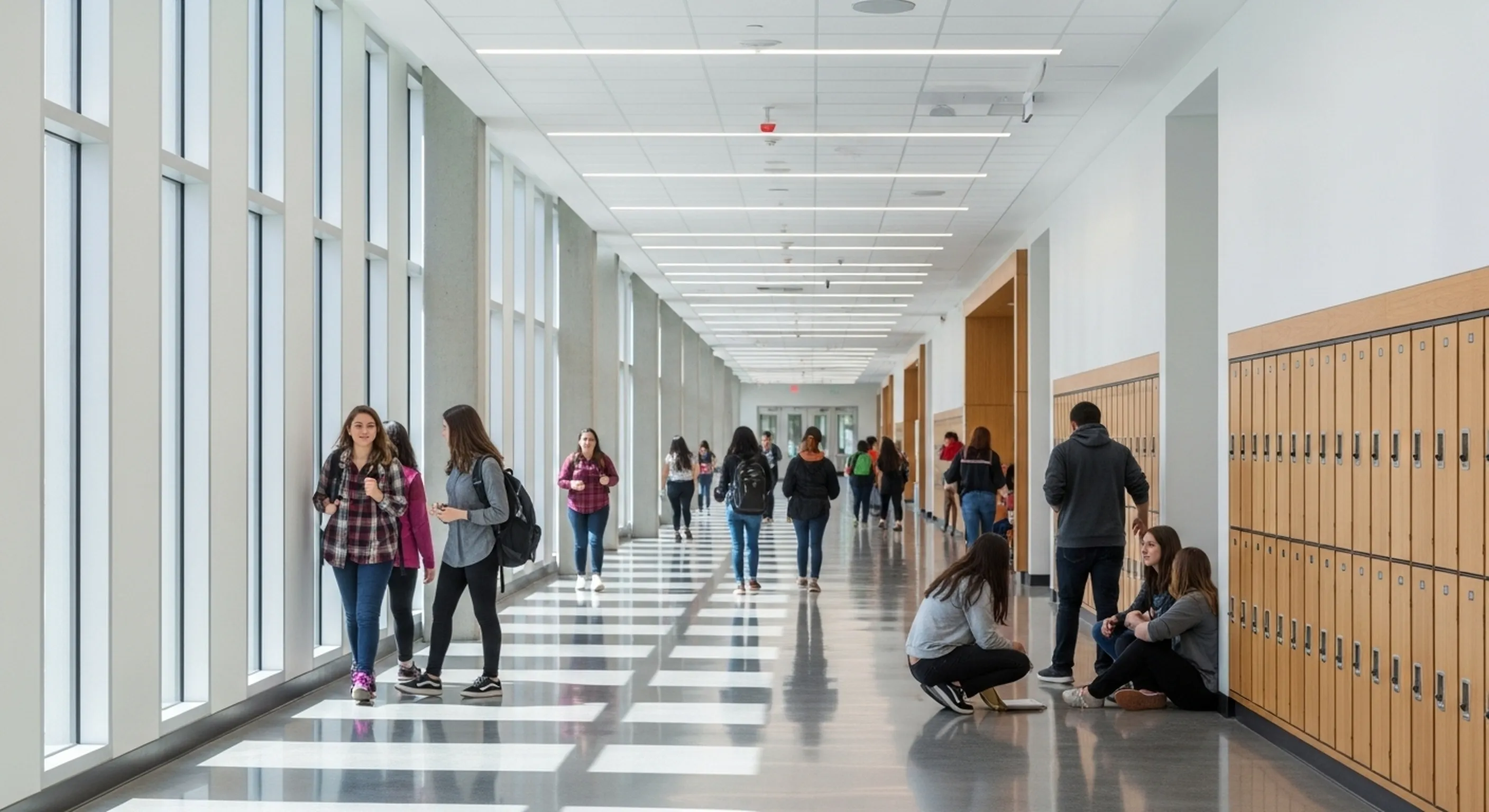
There are several areas of a school that see a lot more foot traffic than others. Transitional spaces like hallways, main corridors, and entry areas take a beating that most commercial floors aren’t designed to handle.
With hundreds of students, rolling AV carts, heavy cleaning equipment, and daily mopping taking its toll, the floor that looked great in year one can look rough by year three if it isn’t made of the right material.
In this guide, we’ll give you a quick look at which flooring materials are right for the daily high-traffic demands of schools.
What Makes High-Traffic School Areas So Destructive for Flooring?
While students and teachers spend most of their time in classrooms, the floors of these spaces don’t see as much foot traffic as those of halls and common areas — which is why the best flooring options for schools vary by space, from classrooms and libraries to gyms and labs.
- High volume of foot traffic across multiple age groups
- Frequent heavy rolling loads on school flooring (AV carts, cafeteria equipment, janitorial carts)
- Constant wet mopping, sweeping, and buffing
- Seasonal grit, dirt, and moisture tracked in from outside
- A tight summer window during which flooring work can be scheduled
With all these extra demands, schools need to consider a lot more than price per square foot when choosing a flooring solution.
Which Flooring Materials Actually Hold up in School Hallways and Corridors?
These are some of the best flooring solutions for high-traffic areas of schools:
LVT (Luxury Vinyl Tile)
LVT is a low-maintenance school flooring solution that works well for a wide range of applications, including high-traffic classroom flooring. It’s resistant to rolling loads when specified with a 5mm wear layer. LVT school floors also hold up under daily cleaning cycles without waxing. LVT is available with a 2.5mm wear layer, but it should only be installed in lower-traffic areas to ensure it lasts.
TARR ratings (texture appearance retention rating) are a reliable way to compare long-term durability between LVT products. This scale assesses how long a flooring product will last and how well it maintains its appearance over time. With higher TARR ratings, school flooring has better durability.
Rubber Flooring
Rubber is an excellent choice for high-impact zones. It’s cushioned, slip-resistant, and naturally resistant to moisture — and that same cushioned surface also helps reduce noise in busy school hallways. Rubber flooring for high-traffic schools also has built-in waxes that make it easier to keep clean. While it isn’t a common choice to install throughout a school, rubber is a common choice for school corridor flooring near gyms and locker rooms.
VCT (Vinyl Composition Tile)
For schools on a tight budget, VCT has a lower upfront cost than other flooring materials. However, it requires regular strip-and-wax maintenance (once or twice a year, usually). This cycle can add labor expense over time, especially for schools with a tight maintenance staff. For schools with dedicated maintenance crews and tight capital budgets, however, VCT is a viable option.
Is LVT Actually Worth the Extra Cost Over VCT in a School Hallway?
When comparing the cost of VCT and LVT for school hallways, it is important to consider upfront vs. life-cycle costs. VCT costs less to buy and install, while LVT costs less to maintain over time.
For schools with limited maintenance staffing, LVT typically costs less in total over a 10-year period. VCT is a good option for schools with established strip-and-wax crews and a tight capital budget.
Ultimately, the choice between VCT vs. LVT in schools comes down to your specific staffing situation and budget. Keep the total school flooring life cycle cost in mind as well.
Does Floor Preparation Affect How Long High-Traffic Flooring Lasts?
Yes, floor prep for schools is an essential step to ensure the longevity of flooring in a high-traffic environment. In fact, this is where a lot of school flooring projects go wrong. Even the best LVT or rubber product will fail early if it’s installed over a subfloor that hasn’t been properly leveled, moisture-mitigated, or prepped.
Floor flatness (FF) and levelness (FL) are two important factors to gather for large corridor installations. Inconsistencies in the subfloor create vulnerable points that can fail early, even with superior materials.
The team at Consolidated Flooring addresses moisture mitigation and floor leveling before any product goes down, every time. That’s because the subfloor is what the product’s performance promise is built on. We’re more than a product supplier; we’re a full-service commercial flooring partner.
To identify the best flooring product for your school, we recommend meeting with one of our flooring experts. Contact Consolidated Flooring to schedule a free, no-obligation consultation.