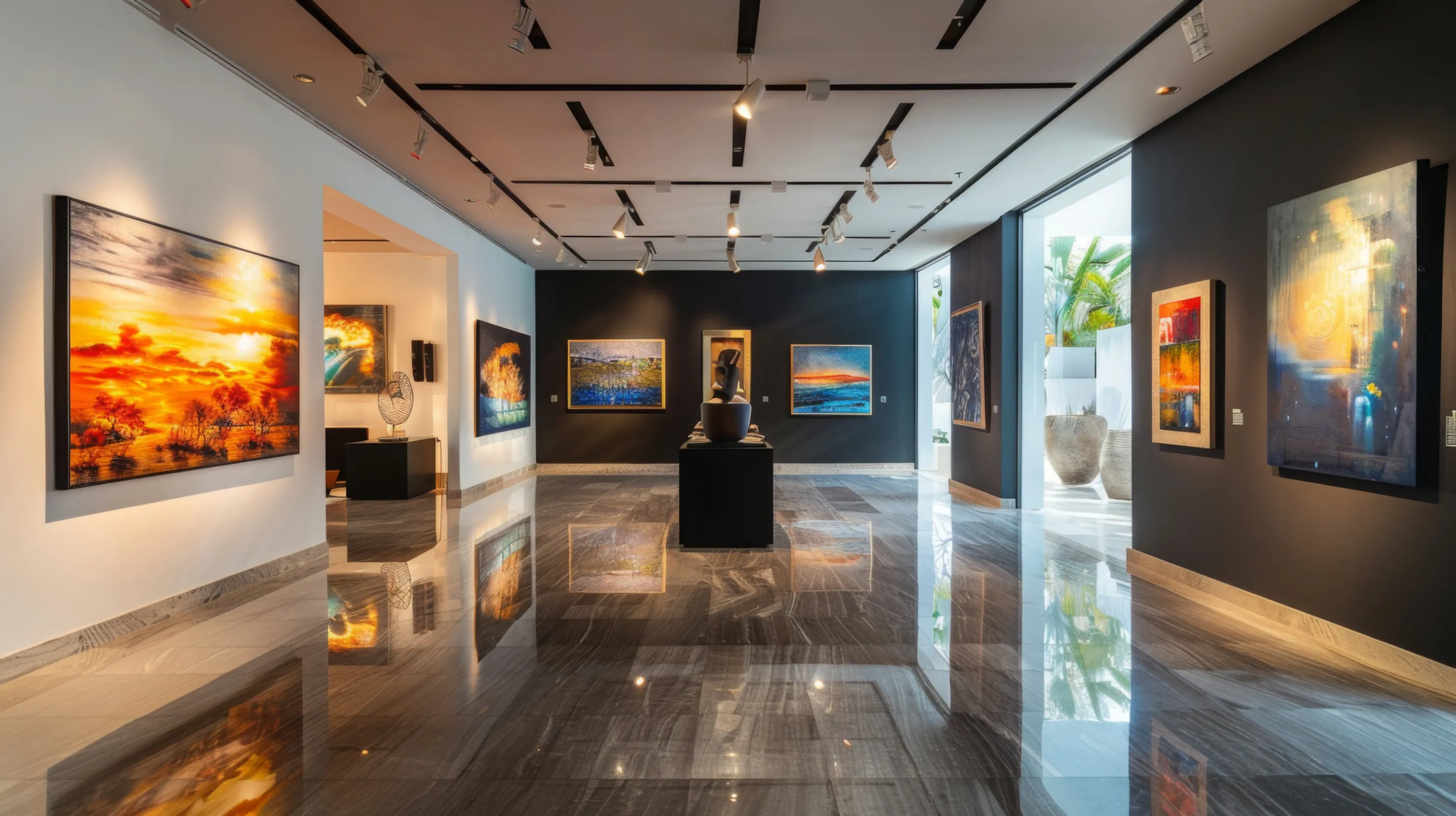
What Flooring Options Are The Most Aesthetically Pleasing For Museums And Art Galleries?
Summary
Museums and art galleries require flooring that balances aesthetic impact with long-term durability, with top options including hardwood, LVT, terrazzo, polished concrete, and natural stone, each suited to specific zones and design intentions.
There is no single best flooring for museums and art galleries, the right answer is the right material matched to each zone. Terrazzo and natural stone bring gravitas to lobbies and entry sequences, polished concrete and hardwood anchor gallery and exhibition spaces, and LVT or carpet tile solve traffic, acoustics, and budget in transitional and back-of-house areas. Which floor *looks* best is a matter of curatorial and design preference; durability, conservation fit, acoustics, low-glare finish, and lifecycle cost are where the specification is actually decided. For a broader view of this vertical, see our overview of commercial flooring for museums, art galleries & libraries.
Key Takeaways
- There is no single best flooring for museums and art galleries: match the material to the zone (lobby vs. gallery vs. conservation corridor vs. back-of-house).
- Terrazzo and natural stone read as permanent and institutional; polished concrete and hardwood suit galleries; LVT and carpet tile add resilience, acoustic control, and value.
- Conservation depends on stable temperature and relative humidity, which ASHRAE and the American Institute for Conservation treat as an HVAC-controlled question, flooring is one contributing factor, not the controlling variable.
- In enclosed exhibition spaces, specify low-VOC materials certified to UL GREENGUARD Gold and pursue LEED credits rather than relying on blanket “safe” claims.
- Hard floors reflect sound while resilient and soft surfaces absorb it, so plan acoustics zone by zone.
- Cost and lifespan are ranges, not fixed figures: terrazzo carries a manufacturer-cited service life of roughly 75 to 100 years when properly maintained.
Why Does Flooring Play Such a Big Role in How a Museum Feels?
Flooring shapes visual cohesion, acoustics, and visitor comfort in ways that are easy to overlook until they go wrong. A floor with a busy pattern under a photography exhibit creates visual noise. A material that amplifies footfall sound disrupts the contemplative atmosphere most cultural institutions work hard to create. And in spaces where thousands of visitors cycle through weekly, the floor has to look as good at year five as it did at installation. That tension between aesthetic authority and relentless durability is exactly what drives the conversation about commercial flooring for museums. The best-looking floor that can’t survive the load isn’t the right answer, and that’s the lens every product decision should run through.
Which Flooring Types Look Best in Gallery and Exhibition Spaces?
There’s no single right answer, and honestly, that’s what makes specifying museum flooring options interesting. The strongest candidates each bring a distinct visual character and a specific set of performance advantages.
Is Hardwood Still the Go-To for Traditional Museum Spaces?
Yes, and for good reason. Hardwood flooring for museums carries earned authority. It reads as serious, timeless, and warm without drawing attention to itself. In traditional gallery settings or historic institutions, it signals that the building respects the work inside it.
Solid hardwood has real limitations in humidity-sensitive environments, though. Think spaces adjacent to collections storage or areas with heavy HVAC cycling. Engineered wood flooring in cultural spaces solves for that. Its dimensional stability across relative humidity changes makes it a smarter spec for most institutional projects, and it can still be screen-and-coated or fully refinished when wear accumulates.
Can LVT Really Look Upscale Enough for a Gallery Setting?
Modern luxury vinyl tile art gallery installations have come a long way from the utilitarian resilient floors of a generation ago. Today’s LVT museum flooring uses printed design layers that convincingly replicate the look of stone and hardwood at a level that holds up to close inspection. A 5mm wear layer is the benchmark for high-traffic institutional installations: it handles rolling equipment, exhibit changeovers, and thousands of daily footsteps without sacrificing the visual.
The appeal for procurement teams is the combination of design quality and total cost of ownership. PVC-free flooring for museums and low-VOC commercial flooring options within the LVT category also support the sustainability specifications that increasingly appear in institutional projects.
For a plain-language primer on the material and its construction, see our guide to what is LVT flooring.
What Makes Terrazzo the Statement Choice for Lobbies and Feature Floors?
Terrazzo flooring for museums earns its own real estate in any design conversation. It’s seamless, and fully customizable with aggregate colors and patterns. It’s also genuinely permanent: well-maintained terrazzo floors are expected to last 75 to 100 years. Frank Lloyd Wright specified terrazzo for the Guggenheim’s ramps in 1957 and called it the “ideal floor.” Those same floors are still in service.
For grand lobbies, entry sequences, and feature gallery floors, terrazzo delivers a level of design intentionality that no other material matches. It also supports LEED v4 credits through recycled content and zero-VOC epoxy systems, which matters to museum procurement teams working against sustainability benchmarks.
What About Polished Concrete and Natural Stone? Are They Worth It?
Polished concrete gallery floors are the contemporary counterpart to terrazzo’s classical authority. Seamless, durable, and customizable with integral color or stenciling, they work especially well in modern art museums and industrial-aesthetic gallery spaces where an honest material palette is the point. Epoxy resin systems offer a high-gloss finish variant worth considering for contemporary spaces that want a more distinctive look.
Natural stone museum flooring is the luxury tier. No two floors are identical, the material is genuinely permanent, and it signals institutional investment clearly. The tradeoffs are a higher initial cost and subfloor loading requirements. Professional specification and proper subfloor prep are prerequisites, not optional add-ons.
Conservation and Environment: Flooring Within a Climate-Controlled Envelope
Stable temperature and relative humidity protect collections, and flooring is one factor within that control — not the controlling variable. Guidance from the American Institute for Conservation (https://www.culturalheritage.org/) and climate criteria published by ASHRAE frame preservation as a matter of HVAC-managed temperature and relative-humidity stability, where sudden swings tend to pose more risk than any single set point. For flooring, that means specifying dimensionally stable assemblies — engineered wood over solid, or terrazzo, polished concrete, stone, and quality LVT that tolerate the humidity cycling common near collections storage and conservation labs.
Coordinate subfloor moisture testing — for example, relative-humidity probe testing under ASTM F2170 — with the building’s environmental targets so the floor performs inside the museum’s controlled envelope rather than fighting it. Treat these figures as targets set by conservators and mechanical engineers, with flooring specified to support them.
Low-VOC and Off-Gassing in Enclosed Exhibition Spaces
In enclosed galleries, specify materials certified as low-emitting rather than assuming any product is inherently “safe.” Adhesives, coatings, and resilient flooring can off-gas volatile organic compounds, and in tightly sealed exhibition rooms those emissions are shared with both visitors and, potentially, sensitive artifacts. The practical standard is third-party certification: look for products certified to UL GREENGUARD Gold for low chemical emissions, and use the USGBC LEED framework, which rewards low-emitting materials, to structure the requirement in procurement. Zero-VOC epoxy terrazzo systems, PVC-free resilient options, and low-VOC finishes let you hold the aesthetic while meeting the certification, rather than relying on a vendor’s unverified assurance.
Acoustics: How Flooring Shapes Sound in Galleries
Acoustics are comparative: hard floors such as terrazzo, polished concrete, and stone reflect sound and can amplify footfall and crowd noise, while resilient surfaces like LVT and soft surfaces like carpet tile absorb more of it. Neither is “right” everywhere — a soaring stone lobby is meant to sound resonant, while a quiet contemplative gallery or a lecture space benefits from surfaces and underlayments that reduce reverberation. Plan the acoustic strategy zone by zone, pairing hard feature floors with soft-surface transitions, acoustic underlayment, and other absorptive finishes where the contemplative atmosphere matters most. For a deeper treatment of the same principle in another high-reflectivity setting, see how flooring impacts acoustics plays out in churches and worship spaces.
Flooring by Zone: Lobby, Gallery, Conservation Corridor, and Back-of-House
The most durable specifications map materials to how each zone is actually used:
- Lobby and entry sequence: terrazzo or natural stone for gravitas, high traffic tolerance, and a permanent first impression. This is where institutions like the Getty set a tone the moment visitors arrive.
- Gallery and exhibition space: polished concrete or hardwood for a quiet, neutral field that lets the art lead, with low-glare finishes to avoid competing with lighting.
- Conservation corridor and areas near collections storage: dimensionally stable, humidity-tolerant assemblies — engineered wood or LVT — that hold up to HVAC cycling and rolling carts.
- Back-of-house and circulation: durable, high-traffic-rated LVT or carpet tile that absorbs sound, resists rolling freight, and is easy to replace tile by tile. Large civic and cultural venues such as the Adler Planetarium show how much of the visitor experience runs through these working zones. Compare full material families in our flooring products & materials catalog.
Cost and Lifecycle: Budgeting Across a 75-to-100-Year Horizon
Museum flooring should be evaluated on lifecycle cost, not just installed price, and every figure below is an approximate range that varies with system, region, and site conditions. As a rough guide, carpet tile and polished concrete tend to sit at the lower end of installed cost, LVT and hardwood in the middle, and terrazzo and natural stone at the top. What reshapes the math is service life: terrazzo carries a manufacturer-cited service life of roughly 75 to 100 years when properly maintained, so its high first cost is amortized over generations, while a resilient floor may be replaced several times across the same span. Weigh installed cost against expected life, refinish cycles, and maintenance labor together. Browse material options and specifications in our flooring products & materials catalog.
Museum and Gallery Flooring Compared
Aesthetic descriptions below reflect common design preferences, not objective ranking; durability, acoustics, and cost are presented as general ranges to guide early planning.
|
Flooring |
Aesthetics |
Durability |
Acoustics |
Maintenance |
Conservation Fit |
Cost est. (installed) |
|
Terrazzo |
Seamless, customizable, institutional gravitas |
Very high; ~75–100 yr cited service life |
Hard, reflective (amplifies footfall) |
Low; periodic polish/reseal |
Excellent; stable, zero-VOC epoxy options |
High; ~$30–90/sq ft (varies) |
|
Polished concrete |
Minimal, honest, contemporary |
Very high |
Hard, reflective |
Low; periodic reseal |
Very good; stable, low-emitting sealers |
Low–moderate; ~$5–15/sq ft |
|
Hardwood (engineered) |
Warm, timeless, traditional |
High; refinishable |
Moderately reflective |
Moderate; screen/recoat, refinish |
Good with engineered stability; watch RH |
Moderate–high; ~$12–30/sq ft |
|
LVT |
Versatile; convincing stone/wood looks |
High with 5mm+ wear layer |
Absorbs more; underlayment helps |
Low; simple to clean, tile-replaceable |
Good; humidity-tolerant, seek low-VOC/PVC-free |
Low–moderate; ~$5–14/sq ft |
|
Carpet tile |
Quiet, soft, patternable |
Moderate–high in commercial grades |
Absorptive; best for quiet zones |
Moderate; vacuum, tile-replaceable |
Fair; specify low-VOC, avoid over sensitive stores |
Low; ~$4–12/sq ft |
We’ve worked with cultural institutions across institutional, civic, and museum environments and know what it takes to get these projects right. If you’re evaluating commercial flooring for galleries and want a team that understands both the aesthetic demands and the operational realities, reach out to Consolidated Flooring. We’re happy to dig into the specifics with you. When you’re ready to scope a project, contact us / request a quote.
How Do You Balance Visual Impact With the Durability Demands of a Museum?
The answer is thoughtful zone-by-zone specification. A lobby that handles 2,000 visitors on a Saturday has different demands than the back-of-house corridor that sees rolling freight. Gallery floors with rotating exhibitions wear differently than permanent collection spaces. Matching the material to the traffic pattern rather than running one product wall-to-wall is how facilities directors protect their investment. The same zone-first logic drives the commercial flooring options for libraries, where a single building has to serve silent reading rooms and high-traffic circulation desks at once.
Routine flooring maintenance, floor prep, and proper floor leveling before installation also matter more than most people realize. The strongest floor underperforms if it goes in over a subfloor that wasn’t ready. Sustainability credentials like Cradle to Cradle, LEED, and PVC-free specs are increasingly appearing in museum procurement requirements and should be part of the conversation from day one.
We’ve worked with cultural institutions across institutional, civic, and museum environments and know what it takes to get these projects right. If you’re evaluating commercial flooring for galleries and want a team that understands both the aesthetic demands and the operational realities, reach out to Consolidated Flooring. We’re happy to dig into the specifics with you.
Frequently Asked Questions
Terrazzo vs. Polished Concrete vs. Hardwood — Which Is Best for a Gallery?
It depends on the look and performance you want. Terrazzo offers the longest service life and the most customization for statement floors; polished concrete gives a minimal, contemporary field at a lower cost; hardwood brings warmth and a traditional feel and can be refinished over time. All three are strong gallery options — terrazzo and concrete are harder and more reflective acoustically, while engineered hardwood is warmer underfoot and better suited to spaces where a softer aesthetic is preferred.
What Flooring Considerations Matter for Conservation and Humidity?
The priority is dimensional stability within a climate-controlled envelope. Because conservators and engineers (guided by AIC and ASHRAE criteria) manage temperature and relative humidity through HVAC, flooring should be specified to support that stability — engineered wood over solid, and terrazzo, concrete, stone, or LVT that tolerate humidity cycling. Confirm subfloor moisture with testing such as ASTM F2170 before installation. Flooring is one contributing factor, not the controlling variable.
What Is the Best Flooring for Gallery Acoustics?
For quieter, more contemplative galleries, absorptive surfaces perform best: resilient LVT with acoustic underlayment or soft-surface carpet tile reduce footfall and reverberation. Hard floors like terrazzo, concrete, and stone reflect sound and are better where a resonant, grand character is intended, such as a lobby. The best approach is comparative and zone-based rather than one material everywhere.
How Durable Does Museum Flooring Need to Be?
It needs to withstand sustained high traffic plus rolling loads from exhibit changeovers and freight, often for decades. Specify commercial-grade assemblies — terrazzo, polished concrete, and stone for the longest life, engineered hardwood and 5mm-plus wear-layer LVT for heavy but more forgiving zones — and verify performance against relevant ASTM flooring test standards for the expected wear.
How Much Does Museum and Gallery Flooring Cost?
Costs vary widely and should be treated as ranges, not fixed prices. As a rough installed guide, carpet tile and polished concrete are typically the most economical, LVT and hardwood are mid-range, and terrazzo and natural stone are the highest first cost. Evaluate lifecycle cost too: terrazzo’s manufacturer-cited 75-to-100-year service life can make its higher upfront price competitive over the life of the building.