Best Flooring Options for Fire Stations and Public Safety Facilities (2026 Guide)
Summary
Fire stations and public safety facilities put flooring through brutal demands, from heavy equipment and chemical exposure to round-the-clock traffic, and standard materials rarely hold up. This guide breaks down the best flooring options for fire stations so you can choose surfaces built to withstand the toughest conditions.
Fire stations and public safety facilities put flooring through brutal demands, from heavy equipment and chemical exposure to round-the-clock traffic, and standard materials rarely hold up. This guide breaks down the best flooring options for fire stations so you can choose surfaces built to withstand the toughest conditions.
Choosing the right fire station or public safety facility flooring is never a one-size-fits-all decision. Fire stations serve multiple functions and need a variety of floor surfaces. In this article from Consolidated Flooring, we’ll walk you through the top fire station flooring options for each area. You’ll find out which qualities to look for in the flooring of each space, as well as the pros and cons of each option.
Best overall for apparatus bays: urethane cement; most cost-effective: sealed concrete with an epoxy/urethane topcoat; best for living quarters: luxury vinyl tile (LVT).
Fire Station Flooring Comparison Table
| Flooring Type | Best Zone | Durability / Load | Thermal Shock | Slip Resistance | Chemical / Oil Resistance | Seamless (Decon) | Relative Cost |
|---|---|---|---|---|---|---|---|
| Urethane cement | Apparatus bay | Excellent (heavy rolling loads) | Excellent | High (w/ aggregate) | Excellent | Yes | $$$ |
| Epoxy broadcast (quartz) | Apparatus bay | Very High | Good | High (quartz grip) | Excellent | Yes | $$ |
| Polyaspartic | Apparatus bay | High | Good | High | Very Good | Yes | $$ |
| Polished/sealed concrete | Apparatus bay | Excellent (uses existing slab) | Fair | Fair (spec anti-slip) | Fair | Yes | $ |
| LVT | Living quarters | High | n/a | Medium | Good | Seams | $$ |
| Rubber | Weight room / wet areas | Very High (cushions impact) | n/a | High | Good | Sheet=Yes | $$$ |
| Homogeneous sheet vinyl | Decon / hygiene | High | n/a | Medium | Very Good | Yes (heat-welded) | $$ |
| Carpet (not recommended) | — | Low | n/a | n/a | Poor | No | $ |
Not sure which system fits your bays and decon zones? Request a quote and we’ll spec every zone of your facility for you.
What Makes Flooring in a Fire Station Different From Any Other Commercial Building?
In the broader category of commercial flooring, fire stations present a unique challenge when it comes to choosing the right material. Public safety facilities like fire stations aren’t a single, homogeneous environment like a retail space or an office. Instead, they function as five or six different zones all under one roof, and each zone has distinct performance demands. For example:
- Apparatus bays: Require flooring that can withstand heavy rolling loads from emergency vehicles, as well as frequent exposure to chemicals, oils, and contaminants.
- Decontamination rooms: Need surfaces designed for strict hygiene requirements, regular cleaning protocols, and frequent exposure to thermal shock.
- Living quarters: Demand underfoot comfort while also being driven by carcinogen requirements.
These are just a few examples of zones in fire stations. There are also fitness areas, offices, and kitchens, and each has its own requirements for flooring specs.
With the multi-faceted nature of a fire station, choosing flooring materials needs to be a zone-by-zone process rather than a single product. That’s why it’s important to consult a commercial flooring dealer rather than a coating-only contractor who covers only one zone.
For a broader look at these environments, see our overview of fire station and public safety flooring.
Why Can’t One Flooring Product Cover the Whole Facility?
There’s no one flooring material that can meet all the needs of every zone of a fire station. The apparatus bay needs chemical resistance, while sleeping quarters require warmth, easy cleaning, and contamination control. The best method is to choose a distinct flooring solution for each zone, although there is some crossover between similar zones, such as kitchens and dining areas.
What Are the Best Flooring Options for Fire Station Apparatus Bays?
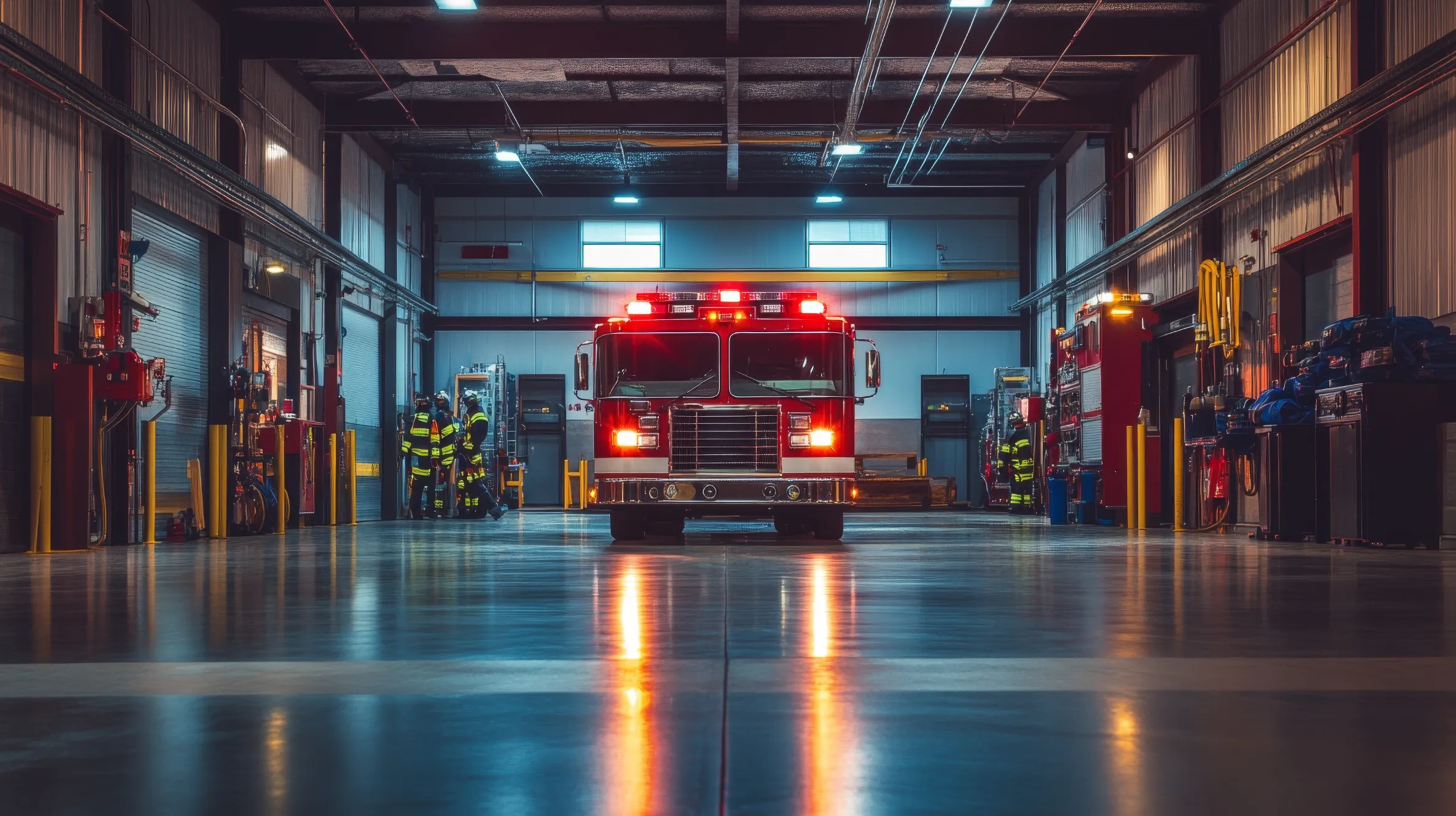
The apparatus bay is one of the most spec-intensive areas of a fire station. Not only do they see heavy foot traffic, but they also have to bear the weight of heavy equipment and vehicles. Between engine heat and frequent opening and closing of bay doors, the floors also see a wide range of temperatures.
Some of the key considerations to keep in mind for apparatus bay flooring options are:
- Chemical resistance: Apparatus bays get exposed to carcinogenic materials, which means they need to be resistant to regular cleaning with harsh cleaning agents.
- Thermal shock tolerance: A rapid shift in temperature, such as a bay door opening on a cold day or the heat from hot washdown water, can cause less durable flooring materials to warp or crack.
- Heavy rolling loads: Fire trucks and heavy equipment mean extreme weight presses down on the flooring and coating.
- Slip-resistance: In an emergency, every second counts, so firefighters need to be able to move quickly in the apparatus bay without fear of slipping and falling.
- Wayfinding options: Apparatus bay flooring often needs custom markings that make it easier to navigate the space in a hurry.
The best flooring options for fire station apparatus bays are resinous options like urethane cement, epoxy, and polyaspartic systems. Urethane cement flooring offers the best resistance to thermal shock and compression. Epoxy flooring for fire stations has superior chemical resistance and is easier to customize with markings. Polyaspartic is similar to epoxy, but offers more UV stability and flexibility.
Even more important than the top coating, though, is the surface preparation of the floor beneath. Proper floor preparation in fire stations helps the coating adhere to ensure an even, durable finish. Even a higher-end product will fail prematurely if applied without sufficient floor prep.
For slip-resistant flooring in fire stations, consider the coefficient of friction provided by a floor. While the ADA doesn’t prescribe a specific COF requirement for firehouse flooring, it should be extremely slip-resistant.
As a practical benchmark, target the wet dynamic coefficient of friction (DCOF) guidance in ANSI A326.3 and ADA accessibility standards, which a broadcast quartz or aggregate finish can help you meet. Slip, trip, and fall prevention here also ties into OSHA safety considerations for public safety flooring.
Why Does Floor Preparation Matter Before Any Apparatus Bay Coating?
The condition of the concrete substrate is crucial to the proper application of resinous coatings. Floor prep should include moisture testing, checking for flatness and leveling (FF/FL), and skim coat or self-leveling prep. The number one reason apparatus bay floors fail early is poor floor prep.
What Flooring Works Best in Fire Station Living Quarters, Kitchens, and Offices?
Carpet used to be a popular choice for offices and fire station living quarters flooring. However, in recent years, there has been a notable shift away from carpet. Even in living spaces, carpet can become contaminated and trap carcinogens, PFAS chemicals, and particulate matter from gear.
Luxury vinyl tile (LVT) has become a dominant flooring option for fire station living spaces and offices. This water-resistant tile is easy to clean and sterilize, reduces noise, and also comes in plank form to simulate hardwood.
For kitchens and dining areas, linoleum is a good seamless flooring option. You might consider tile or sheet rubber flooring for fire station exercise areas and locker rooms, with polished or sealed concrete as a close second.
Fire stations might still use carpet for entryway spaces, however. Carpet can trap contaminants, which can be useful for walk-off mats at the vestibule.
Why Are Fire Departments Moving Away From Carpet in Living Areas?
The reason for the move away from carpet in living areas is the growing concern of contamination. Firefighters returning from the field may track carcinogens and particulates into rest and living spaces. Hard surfaces like LVT fire station floors can be cleaned and disinfected easily, while carpet is difficult to decontaminate completely.
These practices reflect NFPA guidance on fire station contamination control, which emphasizes keeping fireground carcinogens out of living and sleeping areas.
What Do Decontamination Rooms and High-Hygiene Zones Require From a Floor?
With new research into firefighter safety, departments have begun prioritizing health considerations in facility design. The integrity of the decontamination room flooring is essential to minimizing the health risks associated with the profession. This extends to the floors of locker rooms, shower areas, and gear storage as well.
The most important quality for the floors of decon and hygiene-specific areas is a seamless flooring system. That means the floors shouldn’t have porous surfaces or grout lines that can collect contaminants. Seamless floors are also easy to sanitize and power wash for quick decontamination.
For wet areas like showers and freshly hosed decon spaces, slip-resistance is imperative for firefighter safety. The decontamination process also involves harsh chemical agents, which means the floors should be chemical-resistant.
There are several viable options for decontamination room flooring materials:
- Homogeneous sheet vinyl: Using one single sheet of vinyl creates a continuous surface that can withstand heavy wear without trapping contaminants.
- Heat-welded seam systems: To remove grout lines, flooring mechanics use heat to fuse flooring tiles together for a seamless surface.
- Epoxy with coved base: Epoxy is non-porous and seamless, but adding a coved base (rounded corner where wall meets floor) can make decontamination easier and safer.
Rubber tile or sheet makes a good material for hygiene areas like locker rooms, but isn’t recommended for decon hot zone flooring. The ultimate goal with decon room flooring is to keep contaminants and carcinogens in the hot zone and away from living spaces. Most coating-only dealers don’t address the decontamination area, so it’s best to choose an experienced, full-service commercial flooring dealer for fire stations.
8 Best Fire Station Flooring Options, Ranked
Here’s a quick, scannable rundown of the eight materials we recommend, from the toughest apparatus-bay systems down to the option best avoided.
Urethane Cement: Best for Thermal Shock & Heavy Loads
Urethane cement is the top pick for apparatus bays because it shrugs off rapid temperature swings—hot washdown water, cold air rushing through open bay doors—without cracking. It also resists the heavy rolling loads of fire apparatus and stands up to oils and harsh cleaning chemicals. The upfront cost is higher, but its durability makes it cost-effective over the floor’s life cycle.
Epoxy Broadcast Systems: Best Chemical Resistance & Slip Grip
Epoxy broadcast (quartz) systems deliver excellent chemical and oil resistance and are easy to customize with color, safety markings, and wayfinding lines. Broadcasting quartz aggregate into the coating builds in slip resistance for wet, high-speed conditions. Seamless and non-porous, epoxy suits apparatus bays and decon zones alike.
Polyaspartic Coatings: Fastest Cure & UV Stability
Polyaspartic coatings cure fast, letting a bay reopen in as little as a day and minimizing station downtime. They offer strong UV stability so colors won’t yellow near bay doors, plus good flexibility and abrasion resistance. They’re often applied as a quick-return topcoat over an epoxy base.
Polished & Sealed Concrete: Most Cost-Effective
Sealed or polished concrete is the most budget-friendly option because it builds on the slab that’s already there. With an epoxy or urethane topcoat it gains meaningful chemical and abrasion resistance. It’s less forgiving of thermal shock and offers lower slip resistance than a broadcast system, so specify an appropriate anti-slip finish.
Luxury Vinyl Tile (LVT): Best for Living Quarters
LVT is the leading choice for living quarters, offices, and day rooms—warm and quiet underfoot yet easy to clean and disinfect. Its water-resistant wear layer holds up to constant traffic and helps keep carcinogens and particulates from being trapped the way carpet does. Plank formats can mimic hardwood for a more residential feel.
Rubber Flooring: Best for Weight Rooms & Wet Areas
Rubber tile or sheet excels in fitness rooms, locker rooms, and other wet or high-impact areas, cushioning dropped weights and providing dependable slip resistance. Sheet rubber offers a more seamless, sanitizable surface than tile. It’s a strong pick for hygiene areas, though it isn’t recommended for decon hot zones.
Homogeneous Sheet Vinyl: Seamless Hygiene for Decon Zones
Homogeneous sheet vinyl installs as a continuous, heat-welded surface with no grout lines or pores to trap contaminants, making it ideal for decontamination rooms and showers. It can be power-washed and stands up to the harsh chemical agents used in decon protocols. Adding a coved base at the wall makes cleaning even more thorough.
Carpet: Not Recommended for Most Zones
Carpet has largely fallen out of favor because it traps carcinogens, PFAS, and particulates and can’t be fully decontaminated. Its one remaining use is walk-off matting at entry vestibules, where trapping debris is actually helpful. Everywhere else, hard, sealable surfaces are the safer choice.
How Do You Find the Right Commercial Flooring Partner for a Public Safety Facility Project?
What sets a full-service commercial flooring dealer apart from a single-category coating contractor? Coating-only dealers specialize only in certain areas of a fire station, and usually aren’t equipped to handle the spec-intensive needs of decon areas and apparatus bays.
Consolidated Flooring is a full-service dealer, meaning we can cover every zone of a public safety facility. That includes everything from office spaces to apparatus bays to locker rooms. Our team of skilled tradespeople has years of experience installing epoxy systems, LVT, rubber, linoleum, and more.
We’re a proud member of the Starnet network of commercial flooring dealers. With over 80 years of experience, our family-owned business takes pride in delivering a complete flooring service that goes beyond just installing, from floor leveling and moisture mitigation to final cleanup.
As a municipal operation, we fire stations have budget and procurement considerations to keep in mind. In addition to the upfront cost of a flooring system, you also need to factor in the life cycle cost and the amount of operational downtime the installation will require. Consolidated Flooring works around facility schedules to provide a seamless flooring project.
To find out more about the best flooring options for your facility, contact us today to schedule a free, no-obligation consultation.
Frequently Asked Questions
What is the best flooring for a fire station apparatus bay?
Seamless resinous systems—urethane cement for thermal shock, epoxy for chemical resistance, and polyaspartic for fast re-opening.
Epoxy vs. polyaspartic vs. urethane cement—which is best?
Epoxy offers the best chemical resistance and markings; polyaspartic offers the fastest cure and UV stability; urethane cement offers the best thermal-shock and impact resistance.
What flooring is best for fire station living quarters?
LVT—durable, quiet, easy to decontaminate, and softer underfoot than concrete.
Why do decontamination rooms need seamless flooring?
Because there are no grout lines or pores to trap contaminants; the floor can be power-washed and is chemical-resistant.
How slip-resistant must fire station floors be?
Use broadcast quartz/aggregate finishes to meet ADA/ANSI A326.3 wet DCOF slip guidance.
Is carpet allowed in fire stations?
It’s discouraged—carpet traps carcinogens and cannot be fully decontaminated.