What Are The Best Practices For Cleaning Cleanroom Floors?
Cleanroom floor cleaning isn’t something you improvise. The wrong mop, the wrong chemical, or even the wrong stroke pattern can introduce contamination that compromises your entire controlled environment, and potentially your ISO certification. We’ve worked with enough pharma, biotech, and lab facilities to know that the floor is where compliance gets made or broken, and the stakes are too high for guesswork.
Why Does Cleanroom Floor Cleaning Require a Different Approach?
Standard commercial cleaning is designed to remove visible dirt. Cleanroom cleaning is designed to control particles you can’t see. Even physical contaminants like fibers from a conventional string mop can trigger a failed audit. Air showers and shoe covers address contamination before staff enter, but once they’re inside, your cleaning procedures carry that responsibility forward.
What Happens If You Clean a Cleanroom Floor the Wrong Way?
The wrong cleaning agents leave residue that attracts particles. Standard mops shed lint onto the floor surface. Single-bucket setups redeposit contaminants with every pass. In a high-stakes cleanroom environment, these aren’t minor slip-ups; they’re compliance failures that can mean product loss, costly downtime, or regulatory action.
10 Steps for Cleaning a Cleanroom Floor
Cleaning a cleanroom floor correctly requires a set sequence every time. Skipping steps or changing the order introduces contamination risk that your ISO classification cannot absorb.
- Gear up before entering. Put on cleanroom-approved gloves, booties, and a lint-free suit. No outside clothing, no exceptions.
- HEPA vacuum the floor first. Always dry-vacuum before any wet cleaning. This captures settled particles before mopping redistributes them across the floor surface.
- Prepare your 3-bucket setup. Fill one bucket with your validated non-ionic cleaning solution mixed with deionized water, one with clean deionized rinse water, and one for wringing. Never use tap water.
- Work top-down, clean zone to exit. Start from the cleanest area of the room and move toward the door. Never backtrack over areas you have already cleaned.
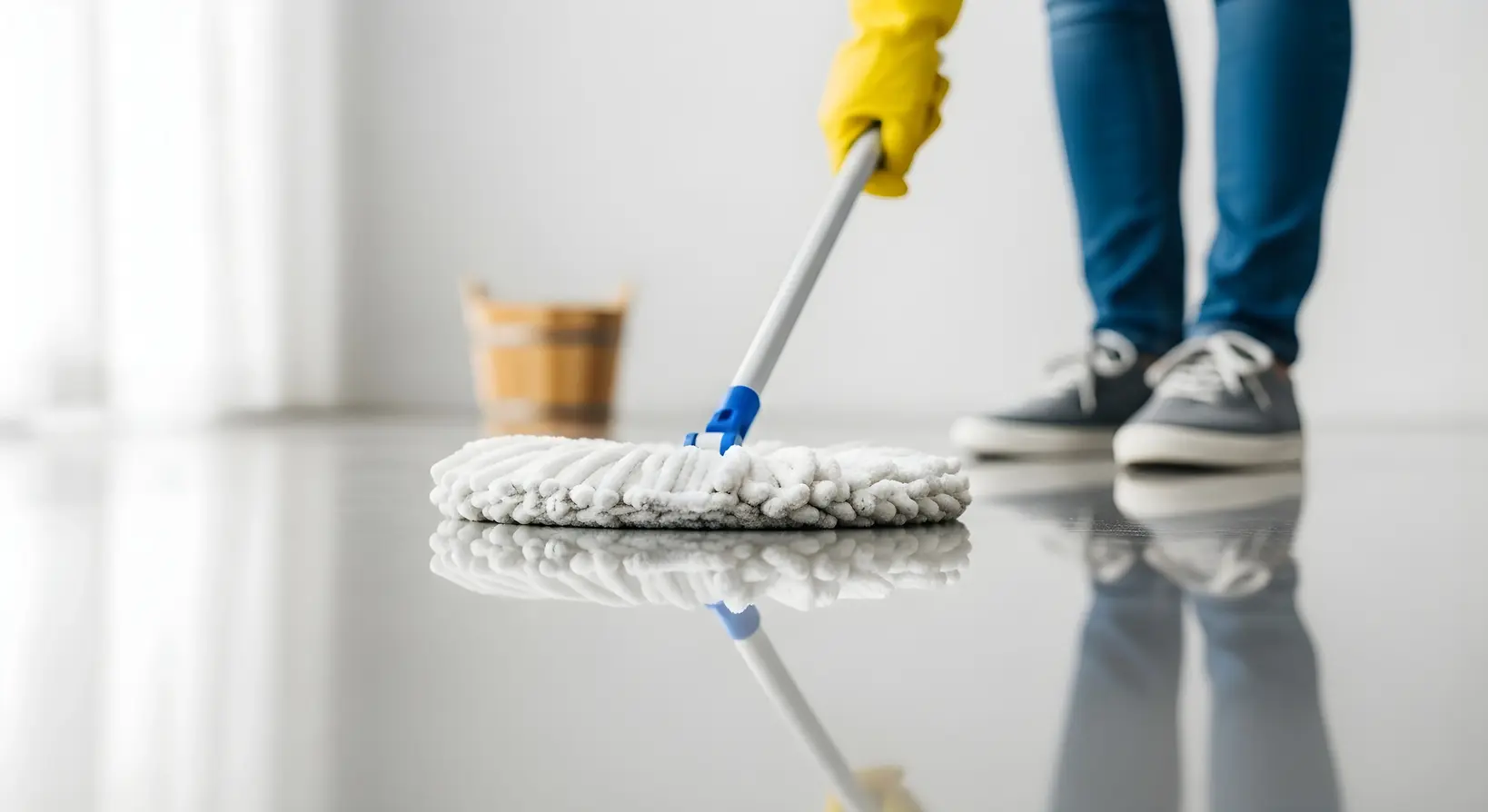
- Mop using a Figure-8 or Lift-and-Pull stroke. Overlapping passes prevent gaps and stop you from dragging contamination back over cleaned sections.
- Change your solution every 10 to 15 square feet. Dirty solution redeposits what you just picked up. Frequent changes are non-negotiable.
- Rinse with deionized water. A second pass with the rinse bucket removes any cleaning agent residue left on the floor surface.
- Allow the floor to fully air dry. Never allow foot traffic on a wet cleanroom floor. Moisture traps particles and creates a contamination risk.
- Dispose of used materials correctly. Mop heads, wipes, and PPE go into sealed cleanroom waste bags before exiting. Nothing leaves loose.
- Log it. Document the date, time, agent used, staff member, and any observations in your cleaning SOP log. This is your audit trail.
What Cleaning Supplies and Agents Are Safe for Cleanroom Floors?
Safe cleanroom-approved cleaning agents are non-ionic, non-foaming, and validated for use in controlled environment spaces. Deionized water is the baseline rinse solution; tap water introduces minerals and microorganisms that don’t belong anywhere near a cleanroom floor. HEPA vacuums handle dry particle removal, and mop heads should be low-lint tubular polyester rather than cotton or standard synthetic blends.
Avoid anything that foams, leaves a film, or isn’t explicitly rated for cleanroom use. Standard janitorial cleaning supplies have no place here.
Does Your Cleanroom Classification Change What Cleaning Agents You Can Use?
Yes, significantly. ISO Class 5 and above require tighter controls on residue, outgassing, and microbial load than Class 7 or 8 environments. Higher-classification spaces may restrict specific surfactants or require validated disinfectants with documented kill claims. Your cleanroom classification should drive every product selection decision on your supply list.
When Should You Use Vaporized Hydrogen Peroxide or a Disinfectant on Cleanroom Floors?
Vaporized hydrogen peroxide and cleanroom-approved disinfectant protocols are typically reserved for higher-ISO-class environments or post-contamination decontamination events. For most routine cleanroom maintenance, a validated non-ionic cleaning solution handles daily needs. Add disinfection steps when your SOP or a contamination event calls for it, not as a blanket default.
Best Practices to Clean Cleanroom Floors
Following a step-by-step process gets you compliant. Following best practices keeps you compliant over time. These are the habits that separate facilities that pass audits from those that don’t.
Always use lint-free, cleanroom-rated mop heads. Standard cotton or synthetic string mops shed fibers directly onto the floor surface. Low-lint tubular polyester is the minimum standard. Replace mop heads on a fixed schedule, not when they look worn.
Use deionized water for every wet cleaning step. Tap water contains minerals and microorganisms that have no place in a controlled environment. Deionized water is the baseline for both your cleaning solution and your rinse bucket.
Match your cleaning agents to your ISO classification. ISO Class 5 environments have stricter residue and outgassing requirements than Class 7 or 8 spaces. Validated, non-ionic, non-foaming agents only. If it isn’t explicitly rated for cleanroom use, it does not belong in the room.
Stick to a documented cleaning frequency. Daily HEPA vacuuming at shift start, weekly full wet mops, and monthly deep maintenance including floor seal evaluation and drain inspection. Ad hoc cleaning is not a protocol.
Train every person who enters the cleanroom on your SOP. Technique inconsistency across staff is one of the most common sources of contamination failure. A written cleanroom SOP cleaning protocol with sign-off requirements protects you during audits and survives staff turnover.
Inspect the floor surface regularly. Chips, cracks, worn seams, or degraded epoxy coatings create particle traps that no mop can fully address. Catch damage early and address it before it becomes a compliance issue.
Choose flooring that supports your cleaning protocol from the start. Seamless surfaces like homogeneous sheet vinyl and epoxy cleanroom floors eliminate grout lines and seams where contamination accumulates. The right floor material makes every one of these best practices easier to execute consistently.
What’s the Right Technique for Mopping a Cleanroom Floor?
Top-down cleaning procedures are non-negotiable: ceiling, walls, equipment, then floor. On the floor, use either a Figure-8 pattern or a Lift-and-Pull stroke with overlapping passes. Both methods prevent dragging contamination back over cleaned areas. Always work from the cleanest zone toward the exit.
Does the Type of Mop Head and Bucket Setup Actually Matter?
A standard string mop in a single bucket is really just a contamination redistribution system. Low-lint tubular polyester mop heads minimize fiber shedding, and a 3-bucket setup (one for clean solution, one for rinse, one for wringing) keeps your clean mop from reintroducing what you just picked up. Use deionized water in both the cleaning and rinse buckets, and change solutions regularly during the shift.
How Often Should Cleanroom Floors Be Cleaned?
Cleanroom cleaning frequency runs on three cadences.
- Daily: HEPA vacuum at the start of every shift to capture settled particles before foot traffic redistributes them.
- Weekly: full wet mop with an approved cleaning solution and the 3-bucket setup.
- Monthly: deeper decontamination tasks including drain inspection, floor seal evaluation, and a full review of your floor surface for damage or wear.
Should You Have a Written Cleaning SOP for Cleanroom Floors?
Yes. Full stop. A written cleanroom SOP cleaning protocol isn’t just good practice; it’s often a regulatory requirement. It standardizes technique across cleanroom managers and staff, survives turnover, and gives you documentation to show auditors. Your SOP should specify approved agents, tools, cleanroom cleaning frequency, technique, and any classification-specific steps.
Does Your Choice of Cleanroom Flooring Affect How Easy It Is to Clean?
Absolutely, and this is where upfront material decisions pay off for years. Seamless options like homogeneous sheet vinyl and epoxy cleanroom floors eliminate the grout lines and seams where particles and microorganisms accumulate. Poured biopolymer and static dissipative flooring add specialized performance for environments managing electrostatic discharge or biological contamination risk. Both are designed to hold up to the rigorous regular maintenance schedules that cleanrooms demand.
At Consolidated Flooring, our mechanics and tradespeople have installed cleanroom flooring materials across pharma, biotech, and research facilities. We know that the right floor doesn’t just survive your cleaning protocol; it makes every shift easier to execute and keeps cleanroom cleanliness standards achievable over years of use. Ready to spec a floor that works as hard as your team? Explore our cleanroom flooring options or reach out to talk through your facility’s specific needs.