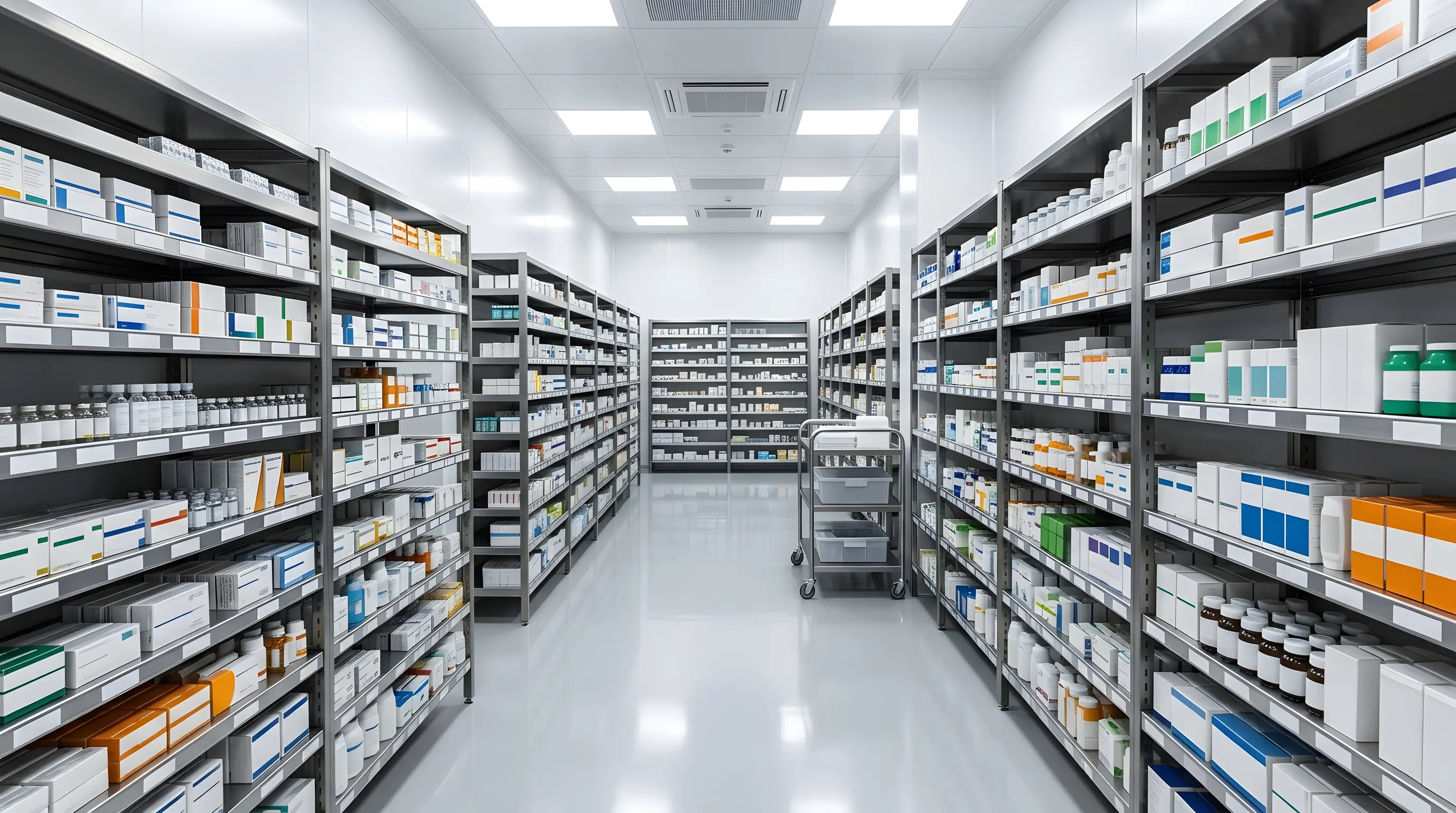
A Guide to Pharmaceutical Flooring
Pharmaceutical flooring isn’t something you spec the same way you’d spec an office corridor or a retail showroom. The floor in a pharmaceutical facility carries real regulatory weight. It’s part of contamination control, it touches GMP and FDA compliance, and a wrong call at the spec stage can mean failed inspections, costly remediation, or production shutdowns. We’ve been doing this for over 80 years, and we still treat these projects with the same level of care on day one.
If you’re a facilities or project manager navigating a pharma build, renovation, or zone upgrade, here’s what you need to know.
Why Is Pharmaceutical Flooring More Demanding Than Standard Commercial Flooring?
Standard commercial flooring is designed to handle foot traffic, look professional, and hold up under routine cleaning. Pharmaceutical environments ask for all of that, plus chemical resistance, contamination control, seamless surfaces, and the ability to survive the kind of cleaning protocols that would destroy a typical floor in six months.
In these controlled environments, the floor isn’t a background feature. It’s a functional asset that directly affects product safety and regulatory compliance. A surface that harbors bacterial growth, traps particulate matter, or degrades under harsh cleaning agents puts your facility at risk, not just operationally, but from an inspection standpoint.
What Do Good Manufacturing Practice Standards Actually Require From a Floor?
Good manufacturing practice standards don’t prescribe a specific flooring product, but they do set clear expectations: surfaces must be cleanable, non-absorbent, and resistant to damage from the chemicals used to sanitize them. In practical terms, that means seamless floors with coved base details (no dirt-trapping joints at the wall), non-porous surfaces that won’t absorb moisture or contaminants, and materials that hold up under stringent cleaning protocols without degrading or discoloring.
Chemical-resistant surfaces are equally non-negotiable. In pharmaceutical manufacturing, floors routinely contact aggressive sanitizers, solvents, and acids. A floor that can’t handle chemical spills or repeated chemical exposure becomes a liability and a premature replacement project you didn’t budget for.
7 Key Pharmaceutical Flooring Requirements for GMP and FDA Compliance
Pharmaceutical flooring is not selected on aesthetics or budget alone. Every material decision has to hold up against a defined set of regulatory and performance requirements before it ever reaches a specification sheet. These are the non-negotiables on every pharmaceutical flooring project we work on.
1. Seamless and Non-Porous Surface
Any floor in a pharmaceutical manufacturing or cleanroom environment must be seamless and non-porous. Seams, grout lines, and porous surfaces are harborage points for bacteria, moisture, and chemical residue that routine cleaning cannot fully eliminate. Seamless resinous flooring and heat-welded sheet vinyl are the two primary systems that meet this requirement across all GMP zones.
2. Chemical Resistance
Pharmaceutical facilities use aggressive disinfectants, solvents, and cleaning agents on a daily basis. The flooring system must resist degradation, staining, and surface breakdown from repeated chemical exposure without compromising the integrity of the seamless surface. Not every epoxy or urethane formulation carries the same chemical resistance rating. Specifying the correct system for the chemicals present in each zone is mandatory.
3. FDA and cGMP Compliance
Under 21 CFR Part 211, pharmaceutical facility surfaces including floors must be constructed of materials that are cleanable, durable, and do not contribute to contamination. This means flooring products must be validated for use in GMP environments, and installation documentation must be available for regulatory inspection. Choosing a contractor with documented pharmaceutical flooring experience is part of meeting this requirement, not just selecting the right product.
4. Coved Base Flooring
Coved base flooring eliminates the right-angle joint where the floor meets the wall, replacing it with a continuous curved surface that extends up the wall. This is a GMP requirement in production and cleanroom zones because right-angle joints collect debris and resist thorough cleaning. Coved bases must be installed as part of the seamless flooring system, not added as a separate element afterward.
5. Slip Resistance
Pharmaceutical facilities involve frequent liquid spills, wet cleaning cycles, and staff moving quickly through production corridors. Flooring must meet ADA and OSHA slip resistance standards under both wet and dry conditions without surface textures that compromise cleanability. The correct coefficient of friction range sits between enough grip to prevent falls and smooth enough to wipe clean under validated disinfection protocols.
6. ESD and Static Control Where Required
In areas housing sensitive electronic equipment, active pharmaceutical ingredient processing, or flammable solvent storage, static dissipative flooring pharmaceutical specifications apply. ESD flooring channels electrostatic discharge safely away from personnel and equipment. This is a zone-specific requirement, not a facility-wide default, but failing to specify it in the right areas creates real operational and safety risk.
7. Moisture Mitigation
Subfloor moisture is the most common cause of pharmaceutical flooring failure. Adhesive bond breakdown, surface bubbling, and flooring delamination in pharma facilities almost always trace back to moisture that was not addressed before installation. Moisture testing, barrier application, and full documentation are required steps on every pharmaceutical flooring project, not optional add-ons.
What Resin Flooring Systems Are Used in Pharmaceutical Environments?
Resinous flooring systems are the dominant choice across the pharmaceutical industry because they deliver the seamless, non-porous, chemically resistant surface that GMP-compliant facilities require. Within that category, the right flooring system depends on the specific demands of each zone.
Epoxy systems are the workhorse of pharmaceutical cleanroom flooring and general manufacturing areas. They offer excellent chemical resistance, strong abrasion resistance, and a seamless, hard surface that cleans easily. For areas facing rapid temperature changes or thermal cycling — common in pharmaceutical facilities with wash-down operations or autoclaving — polyurethane systems (also called urethane flooring systems or PU flooring) are often the better choice. Urethane mortar, in particular, handles thermal shock that would crack a standard epoxy over time.
For occupied facilities or active production areas, low odor formulations and fast-curing options matter. Premature failure from a rushed or ill-suited system is far more disruptive than taking the time to spec the right product up front. Also, some resinous floors are specifically engineered for fast turnaround to minimize operational disruption.
When Does a Pharmaceutical Facility Need ESD Flooring?
Electrostatic discharge is a genuine hazard in powder processing, tablet manufacturing, and certain packaging environments. Static buildup can ignite combustible dust, damage sensitive equipment, or compromise product integrity. In those controlled environments, ESD flooring isn’t a recommendation. It’s a requirement. Static-control resinous flooring systems are designed to safely dissipate electrical charges, and they need to be specified and installed with grounded copper strips to actually perform. This is one area where cutting corners on the flooring spec has real safety consequences.
Does Every Zone in a Pharma Facility Need the Same Flooring Solution?
No, and this is where a lot of pharmaceutical facilities run into trouble. The same flooring material that’s ideal for a cleanroom may be over-engineered for a corridor or entirely wrong for a loading dock.
Cleanrooms and primary manufacturing floors need the highest level of seamless, chemical-resistant, ESD-appropriate high-performance flooring. Gowning rooms and clean rooms adjacent to production require similar properties, but may have slightly different load or traffic profiles. Wash-down areas need slip resistance and heavy-duty chemical-resistant surface performance. Corridors and common areas carry high traffic but face fewer contamination requirements. Warehouse and loading dock zones take rolling loads, forklift traffic, and need a different kind of heavy-duty durability than a controlled manufacturing space.
Zone-by-zone flooring design isn’t just good practice. It’s cost management. You shouldn’t be spec’ing pharmaceutical-grade epoxy flooring in a storage room any more than you’d put a basic floor coating in a sterile fill suite.
5 Common Pharmaceutical Flooring Materials
Selecting the right pharmaceutical flooring material starts with understanding what each system is designed to do and where it performs best. Here is how the most common options compare across the requirements that matter most in pharma environments.
1. Epoxy Resinous Flooring
Epoxy is the most widely specified flooring for pharmaceutical manufacturing zones, sterile processing areas, and high-chemical-exposure environments. Poured as a liquid, it cures into a fully seamless, non-porous surface with outstanding chemical resistance and compressive strength. It handles heavy rolling loads from production equipment and pharmaceutical carts without cracking or delaminating. Available in static dissipative formulations for ESD-sensitive zones. Coved base installations are straightforward with epoxy systems. Best for: production floors, sterile manufacturing zones, API processing areas, and labs with heavy chemical exposure.
2. Urethane Flooring Systems
Urethane is the preferred system for pharmaceutical environments where thermal cycling, impact resistance, and chemical exposure combine. Unlike epoxy, urethane has a degree of flexibility that prevents cracking under dynamic loads and temperature changes. It resists a broader range of acids and is particularly well suited to facilities with cold storage areas or environments where floors are subject to steam cleaning and high-temperature washdowns. Best for: cold storage, washdown areas, and manufacturing zones with high thermal variability.
3. Homogeneous Sheet Vinyl with Heat-Welded Seams
Heat-welded sheet vinyl creates a continuous monolithic surface by fusing seams with a heat gun, eliminating joints entirely. It meets GMP requirements for seamless flooring in cleanroom and pharmaceutical production environments and is softer underfoot than resinous systems, which benefits staff in high-standing-time areas. It resists a wide range of pharmaceutical cleaning agents and disinfectants and is faster to install and replace than poured systems. Best for: pharmaceutical cleanrooms, compounding pharmacy flooring, packaging areas, and corridors adjacent to sterile zones.
4. Epoxy vs Sheet Vinyl Pharmaceutical Flooring
The choice between epoxy and sheet vinyl comes down to three factors: chemical exposure intensity, rolling load requirements, and installation timeline. Epoxy outperforms sheet vinyl in environments with heavy chemical exposure and high-PSI rolling loads. It is the correct call for sterile manufacturing floors, API processing zones, and anywhere that requires a poured, integral coved base. Sheet vinyl is the better option where installation speed, budget, and underfoot comfort are priorities and chemical exposure is moderate. Both systems meet GMP seamless flooring requirements when installed correctly. The wrong choice is using sheet vinyl in a zone that demands the chemical resistance of a resinous system, or specifying epoxy in a space where a faster, more cost-effective vinyl installation would perform equally well.
5. Urethane vs Epoxy for Pharmaceutical Facilities
Urethane costs more than standard epoxy but justifies the premium in thermally demanding environments. If your facility runs washdown cycles, houses cold storage, or operates at temperature extremes, urethane’s flexibility and thermal resistance prevent the cracking and delamination that epoxy systems can experience under those conditions. For standard production and cleanroom environments without significant thermal variation, epoxy remains the more cost-effective and widely validated choice.
What Should You Look for in a Commercial Flooring Dealer for a Pharmaceutical Project?
High-performance flooring in pharmaceutical environments demands a dealer who understands the full scope of the project, not just the product catalog. That means site assessment, concrete slab evaluation, moisture mitigation planning, coordination with your cleanroom design team, and an understanding of which systems will hold up under your specific operational demands.
We’ve been working in pharmaceutical manufacturing, biotech, and cleanroom environments long enough to know that the flooring spec is only as good as the execution behind it. Our skilled installation mechanics handle the full process, from estimating and flooring specification through floor leveling, installation, and long-term maintenance. We work directly with facilities teams as well as through general contractors and architects on pharmaceutical cleanroom projects across our locations in New York/New Jersey, Chicago, Indianapolis, Fort Lauderdale, and San Antonio.
If you’re planning a pharmaceutical facility build or renovation and want a flooring partner who’s navigated these environments for over 80 years, we’d like to talk. Contact Consolidated Flooring to connect with our team.