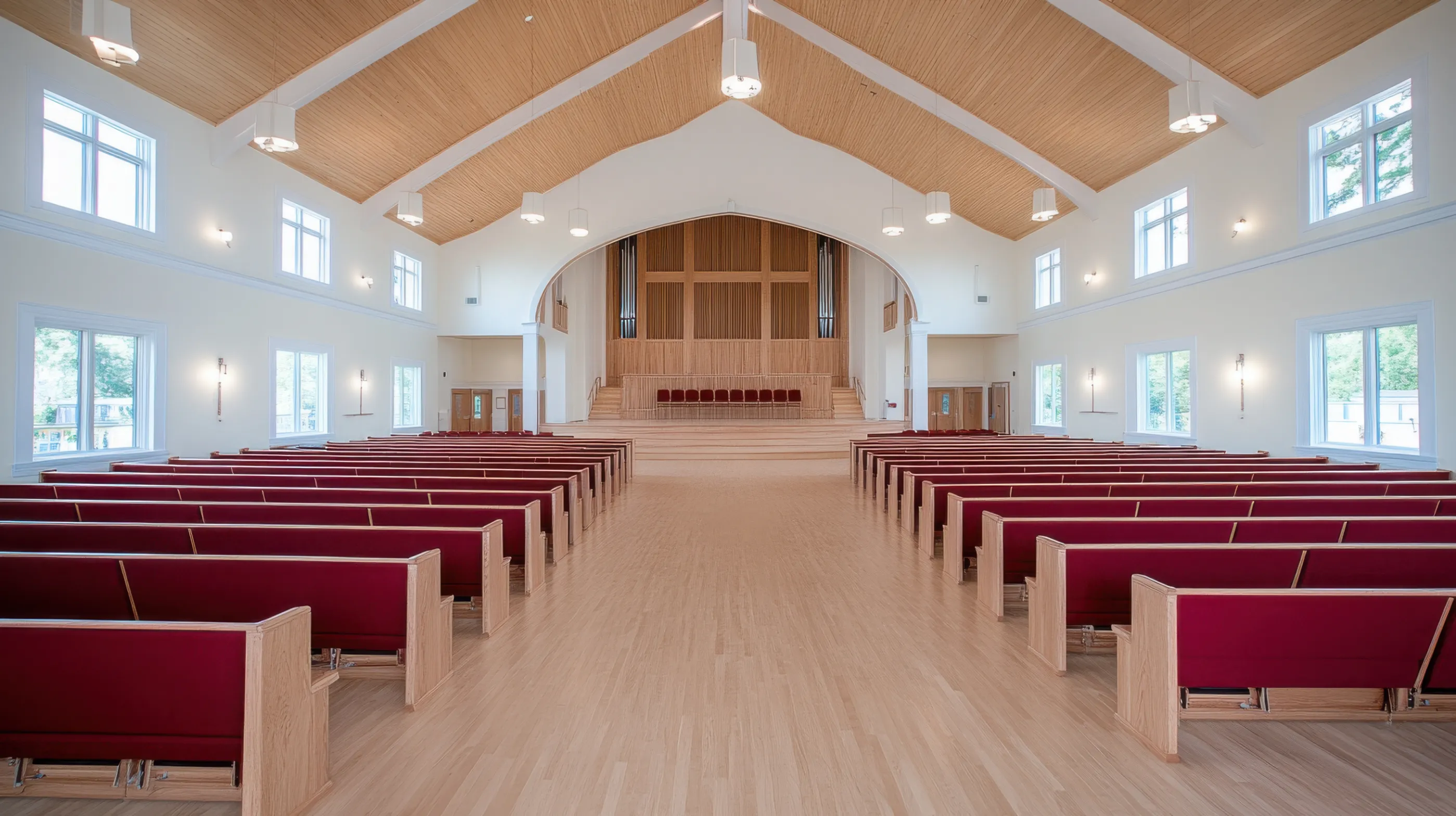
Best Flooring for Church Fellowship Halls and Multi-Use Spaces
Quick answer: The best flooring for a church fellowship hall handles point loads, spills, acoustics, and mixed use at once. Luxury vinyl tile (LVT) with an SPC core and a 20-mil-plus wear layer is the most practical all-purpose choice; carpet tile suits seated, acoustic-heavy programming; rubber fits halls with an athletic component; and hybrid resilient works when use is split evenly. Subfloor prep and a maintenance plan matter as much as the material itself.
Fellowship halls are some of the most punishing floors in commercial real estate, and they rarely get treated that way. One Saturday, it’s a wedding reception with round tables, folding chairs, and a buffet line. The next morning, it’s Sunday school. By Thursday, the youth group has rearranged the space for a basketball scrimmage. If you’re familiar with the best flooring for church fellowship halls, you already know the generic commercial floor catalog doesn’t provide all the information you need. Let’s dig into what actually works for multi-use church flooring.
What Makes Fellowship Hall Flooring Different From Other Commercial Floors?
A standard office floor handles rolling chairs and foot traffic. A retail floor handles carts and steady pedestrian loads. A fellowship hall handles all of that, plus folding furniture that gets dragged, stacked, collapsed, and stored in rapid succession, often by volunteers who aren’t thinking about floor protection.
The result is a spec that needs to check five boxes simultaneously: durability under point loads, slip resistance for a congregation that spans every age, acoustic performance so a speaker doesn’t echo off a hard surface, cleanability after potlucks and craft nights, and enough design flexibility to look appropriate for both a funeral reception and a children’s carnival. That’s a different ask than most commercial flooring for religious facilities projects.
Why Do High-Traffic, Multi-Use Spaces Demand a Different Spec?
Point loads are the issue most facility managers don’t think about until after the floor is damaged. When a narrow chair leg or rolling cart wheel concentrates weight into a small contact area, the pressure per square inch can far exceed what a standard foot-traffic spec anticipates. A folding banquet table with 150 lbs of food on it, balanced on four narrow legs, applies a very different force profile than a person standing in that same spot.
This is where indentation resistance and residual recovery become the relevant spec criteria. Indentation resistance measures how well a material resists deformation under a static load. Residual recovery measures how much it bounces back once the load is removed. For multi-use church flooring that sees furniture moved in and out weekly, a product that deforms easily and recovers slowly will show permanent impressions within a year, no matter how beautiful it looked on day one.
Which Flooring Materials Actually Work in a Fellowship Hall?
There’s no single right answer here. The honest call depends on how your hall is actually used: what percentage of programming is food-service, athletic, worship overflow, or seated community events. We’ve worked with enough commercial flooring houses of worship projects to know that the facility manager who picks based on one use case and ignores the others ends up calling us back sooner than they’d like and accessibility is one of the dimensions most commonly left out of the initial spec. Our guide to ADA flooring standards for churches covers what that layer of planning looks like in practice.
Fellowship Hall Flooring Options Compared (Quick Reference)
| Material | Best Fit (Programming) | Key Strength | Watch-Out | Approx. Lifespan |
|---|---|---|---|---|
| Luxury vinyl tile (LVT), SPC core, 20-mil+ wear | Diverse, all-purpose use | Water/stain resistant, easy to clean, wide design range | Chair-leg gouging without glides; needs double glue-down | 15-25 years |
| Carpet tile | Seated, acoustic-heavy events | Sound absorption, comfort, replace single tiles | Poor for food service or athletic use | 8-15 years |
| Rubber sheet / tile | Halls with an athletic component | Exceptional point-load and rolling-load performance, slip resistance | Reads as a gymnasium aesthetically | 20+ years |
| Hybrid resilient | Evenly split athletic / social / seated | Rigid core plus textile-like acoustics | Not best-in-class at either extreme | Varies by product |
Is LVT the Right Call for Spaces That Do Everything?
Luxury vinyl tile for churches is, in most cases, the most practical starting point for fellowship halls with genuinely diverse programming. The reasons are straightforward: its water and stain resistance handles spill-heavy events without the panic; the surface is easy to clean with standard commercial maintenance equipment; and the design catalog is wide enough to fit a sanctuary-adjacent aesthetic without looking institutional.
The performance caveat worth knowing is this: LVT multi-use spaces require attention to both wear layer and installation method. Commercial LVT applications call for wear layers in the 20-mil-and-above range to hold up reliably against heavy foot traffic, indentation, and daily use. For fellowship halls, we typically recommend 5mm wear layer LVT with an SPC (stone plastic composite) core, which delivers superior indentation resistance compared to softer WPC cores. On the installation side, double glue-down installation — adhesive bonded to both the subfloor and the back of the tile — is the spec that keeps point load flooring performing over the long haul. Loose-lay is an option in lower-traffic zones, but not for a space where rolling carts and folding furniture are constants.
One thing to address directly: chair leg gouging is a real concern with LVT, and it’s often a function of the glide or cap on the chair leg, not just the flooring. We always recommend pairing the right LVT spec with proper furniture glides. It’s an inexpensive detail that protects a significant investment.
When Does Carpet Tile Make More Sense Than Hard Surface?
Carpet tile for churches earns its place in fellowship halls that skew heavily toward seated programming: community meetings, worship overflow seating, lecture-style events, or grief support groups where acoustic softness and underfoot comfort matter. The acoustic argument is real. Hard surface floors amplify ambient noise in a way that makes conversation-heavy events feel chaotic. A well-spec’d carpet tile with appropriate backing can meaningfully reduce that reverberation without requiring a separate acoustic underlayment system.
When evaluating acoustic flooring church applications, look for TARR ratings (Texture Appearance Retention Ratings), a Carpet and Rug Institute standard, alongside IIC (Impact Insulation Class) ratings for any underlayment. Higher TARR ratings indicate better long-term appearance retention under traffic, which matters in a space where the carpet needs to look presentable for events, not just survive daily foot traffic.
The honest limitation: carpet tile for churches is not the right call for fellowship halls with consistent food service or athletic programming. Spilled punch, court markings, and rubber-soled athletic shoes are all unkind to carpet, and no amount of stain treatment changes that calculus. If your hall runs a weekly meal ministry or doubles as a gym, carpet tile is a secondary zone material at best.
What About Rubber and Hybrid Resilient Options?
Rubber sheet and rubber tile deserve a mention for fellowship halls with a genuine athletic component. Rubber delivers exceptional point load performance, is essentially impervious to rolling loads, and can support slip-resistant flooring church requirements in wet or high-traffic transition zones. The tradeoff is aesthetic: rubber reads as a gymnasium, not a community gathering space, and that’s a tension worth acknowledging in a multi-use spec.
Hybrid resilient flooring — products that combine the dimensional stability of a rigid core with textile-like acoustic performance — is an emerging category worth discussing if your space genuinely can’t choose between hard surface and carpet performance. These products don’t replace either material at the extremes, but for a hall that splits its programming roughly evenly between athletic, social, and seated uses, hybrid resilient can be a practical middle ground.
What Else Should You Be Thinking About Before You Spec a Floor?
The flooring material decision gets a lot of attention. The subfloor preparation decision gets almost none — until something goes wrong. In our experience, more fellowship hall floor failures trace back to inadequate prep than to product selection.
Floor leveling matters more in multi-use spaces than in standard commercial applications because point loads will find and exploit any subfloor irregularity over time. If you’re going into an older facility, moisture mitigation and a skim coat aren’t optional line items. They’re what separates a floor that lasts 15 years from one that starts failing at five.
Entrance mat systems are another detail worth building into the spec from the start. A well-designed entrance grid or walk-off system at every entry point captures soil, moisture, and grit before it reaches the field flooring. For a fellowship hall that sees high event turnover with lots of entry-exit traffic, entrance mat performance directly affects how the main floor holds up between professional cleanings.
Accessibility is another factor that belongs in the spec from the start. Flush transitions between flooring zones, slip-resistant surfaces near entrances and serving areas, and firm surfaces that allow easy rolling for mobility aids all support compliance with ADA accessibility standards and, more importantly, a congregation that spans every age and ability.
Finally, don’t finalize a spec without a maintenance plan. Durable church flooring requires initial maintenance. The protective finish should be applied after installation, before the space opens to traffic. From there, a routine that matches the product and the use intensity is what protects your investment. A beautiful LVT floor without a proper maintenance program will look tired well before it should. We include maintenance planning in every project conversation because the floor you spec and the floor you maintain are the same floor.
How Do You Find a Commercial Flooring Partner Who Gets Multi-Use Spaces?
This is where the spec conversation either gets real support or falls apart. General contractors can coordinate a flooring installation. A residential operation can handle straightforward replacement work. What fellowship hall projects actually need is commercial flooring solutions for religious facilities with the product access, specification depth, and field experience to navigate a space that doesn’t fit neatly into a single product category.
At Consolidated Flooring, we’ve been doing this work for 80+ years across markets in New York, New Jersey, Chicago, Indianapolis, Fort Lauderdale, and San Antonio. Our skilled mechanics and tradespeople handle complex installs, which may include occupied facilities, phased schedules, and sensitive adjacencies to active worship spaces. We also have a Starnet membership that gives us access to manufacturer relationships and resources that independent or smaller operations simply don’t have.
If you’re working through a fellowship hall renovation or replacement and want a partner who can spec it right the first time, reach out to our team for a discovery conversation. The right floor starts with the right spec — and that’s a conversation worth having before you’re committed to a product.
Frequently Asked Questions
What is the best flooring for a church fellowship hall?
For most halls, luxury vinyl tile (LVT) with an SPC core and a 20-mil-plus wear layer is the most versatile choice because it handles spills, point loads, and mixed use. Carpet tile is better for seated, acoustic-heavy programming, and rubber suits halls with a real athletic component. Many halls zone two materials.
Is LVT or carpet tile better for a fellowship hall?
LVT is better for halls with food service, athletic use, or heavy furniture movement; carpet tile is better where acoustics and underfoot comfort matter most, such as seated meetings and overflow seating. A common approach is LVT in high-traffic and dining zones with carpet tile in quieter areas.
What LVT wear layer and core should a fellowship hall use?
Specify a wear layer of 20 mil or more and an SPC (stone plastic composite) core for strong indentation resistance, installed with double glue-down adhesive. Loose-lay is acceptable only in low-traffic zones, not where rolling carts and folding furniture are constant.
How do you reduce echo and noise in a fellowship hall?
Carpet tile absorbs sound best; LVT with an attached acoustic underlayment helps with hard surfaces. Look for TARR and IIC ratings, and pair hard-surface floors with acoustic ceiling panels or rugs in conversation-heavy areas.
How long does fellowship hall flooring last?
With proper maintenance, LVT lasts about 15 to 25 years, carpet tile 8 to 15 years, and rubber 20 years or more. Subfloor preparation and a routine maintenance plan have a major effect on how long any material lasts.
Can carpet work in a fellowship hall that hosts meals or sports?
Not as the primary floor. Spilled food, drinks, court markings, and athletic shoes are hard on carpet. In halls with regular meal ministries or gym use, keep carpet to secondary, seated zones and use LVT or rubber in the active areas.